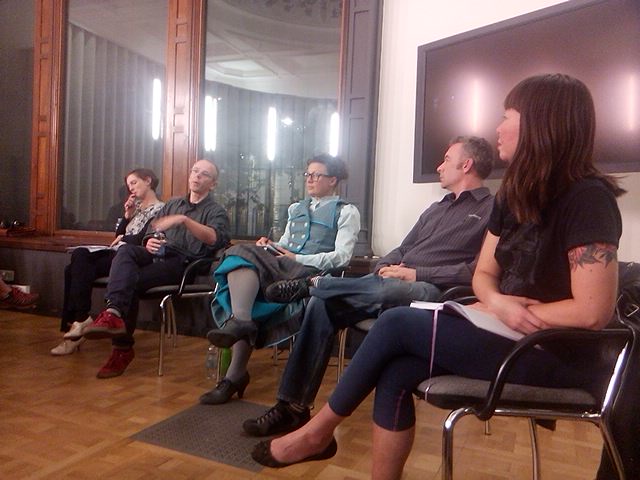
Design Culture Salon 12: Is innovation overrated and what is the role of design here?

Friday 12 Dec 2014

6:30-8:30pm

Clore 55, British Galleries, V&A Museum

Government think-tanks, policy wonks, business gurus, management book publishers and lots and lots of design commentators stress a need for innovation in order to ‘compete globally in these turbulent times’. Alternatively, innovation also gets tacked onto thinking about how new social arrangements, welfare services or participatory processes can unfold. But has innovation become an unthinking default position? Is this verve to aim for invention actually missing important challenges like implementation, poor leadership or infrastructure? What is the role of the State in promoting particular versions of innovation? Can designers provide a critical space where something else might happen? This Salon investigates how a certain cultural understanding of innovation has emerged, what it is doing and how alternatives might be forged.

Chair: Guy Julier, Professor of Design Culture, University of Brighton and Victoria and Albert Museum

Panel:
Jamie Brassett, Subject Leader & MA Course Leader, Innovation Management, Central Saint Martins, London
Duncan Fairfax, Lecturer in Design, Programme Leader MA in Design & Environment, Goldsmiths, London
Lucy Kimbell, Principal Research Fellow University of Brighton and Associate Fellow, Said Business School

Dr Jamie Brassett has been working at Central Saint Martins college of the University of the Arts London since 1995 working across most of its subject provision – product design, fashion design, graphic design, textile design and fine art – and has been Subject Leader and MA Course Director of Innovation Management since 2008. Jamie has also consulted for a number of design and innovation agencies, and global commercial, public and voluntary sector organisations. He graduated with a PhD in Philosophy from University of Warwick in 1993, producing a thesis on Deleuze and Guattari, Kant and Bachelard called Cartographies of Subjectification, supervised by Nick Land. Jamie has published on a number of topics since 1991 and has spoken nationally and internationally at conferences since 1989, chairing ‘Out of Control’ the 8th International Conference on Design and Emotion in 2012. A volume for Edinburgh University Press called Deleuze and Design, co-edited with Betti Marenko, is to be published in June 2015. His own work for this book deals with philosophy, design, innovation and biology. Jamie is currently working on projects covering style and design, futures and trends, materialism and ontogenesis, sometimes all at the same time.

Duncan Fairfax is the current director of the Prospect and Innovation Research Studio (Pi) at Goldsmiths, University of London. He lectures in both the Design Department, and the Institute for Creative and Cultural Entrepreneurship at Goldsmiths, and Trinity College Dublin. His research and teaching areas include Leadership, Innovation, Management, Design Process/Thinking, and Sustainability.

Dr Lucy Kimbell is Arts and Humanities Research Council (AHRC) Research Fellow embedded in the Cabinet Office Policy Lab, part of the Open Policy Making team, and Principal Research Fellow at the University of Brighton. She was co-Principal Investigator leading a study on Mapping Social Design Research and Practice, the report of which was published in September 2014. Since 2005, she has taught an MBA elective in Designing Better Futures at Said Business School, University of Oxford, where she is Associate Fellow. For Central Saint Martins, University of the Arts London, she scoped and designed a new MBA programme centred on creativity and design. Lucy was previously Head of Social Design at the Young Foundation and her new book Service Innovation Handbook will be published by BIS in early 2015, aimed at managers and entrepreneurs trying to design new services.

The Salon is now fully booked, but you can contact me, L.Armstrong@vam.ac.uk, to join the guest list.

Posted in Uncategorized | Leave a comment

Reflections on Design Culture Salon 11: How do fashion cycles and design culture interact?

Reflections on Design culture salon 12: How do fashion cycles and design culture interact?

Panel L-R, Marloes ten Bhomer, Cher Potter, Lisa White, Joanne Entwistle, Chris Breward.

Panel L-R, Marloes ten Bhomer, Cher Potter, Lisa White, Joanne Entwistle, Chris Breward.

For those working in the field of design culture, the term ‘trend’ carries an awful lot of baggage. Specifically, for those interested in sustainability, the term and its associates (‘fast fashion’ and ‘fashion cycle’) are regularly deployed as ‘dirty words’ in design discourse. Design researchers can also be guilty of discussing these concepts as if they are distinct and separate to the study of design culture. It is something happening ‘over there’ in fashion studies. So, how have these barriers come to exist between the study of fashion and design culture? What can we learn, as design researchers, from the theories and ideas generated through the study of fashion cycles? This salon aimed to ask some reflexive and self-critical questions about the apparent division between design and fashion research and seek a more productive conversation between the two.

Fashion historian Professor Chris Breward, Principal of Edinburgh College of Art, offered an interesting route into this conversation by introducing one of the most fundamental questions that binds together the study of design culture and fashion cycles: time. Specifically, he suggested that fashion theory has something to offer design culture here, in its discussion of fashion as an embodiment of time and space. To illustrate this point, he quoted a wonderful passage from the diary of an American woman returning from China to New York in 1947, published in Fred Davis’ important text, Fashion Culture and Identity:

At every airport where we stopped on the way back from China I started watching the women coming the other way. At Calcutta the first long skirt and unpadded shoulders looked like something out of a masquerade party. At the American installations in Frankfurt (also in Vienna) a lot of the newer arrivals were converted and were catching everyone’s attention. At the airport in Shannon I had a long wait; I got into a conversation with a lady en route to Europe. She was from San Francisco, and told me that there they hadn’t been completely won over; just as many were wearing the long skirts as not. But as she flew East, she found that just about everybody in New York had gone in for the new styles and she was happy she wasn’t staying or her wardrobe would have been dated. By the time I took the train from New York for home, my short skirts felt conspicuous and my shoulders seemed awfully wide! Two weeks now and I am letting down my hems, trying to figure out which of all my China-made clothes can be salvaged, and going on a buying spree!

  • Langs (1961:470), quoted in Fred Davis, Fashion, Culture and Identity, (1992), p.151.

This narrative presents fashion, literally and physically, in motion.  This experience is at odds with our experience of fashion culture today, Breward suggested. The fashion cycle is now intensely regularized by a wider constituent of agents, encompassing the media, fashion forecasters, futurologists and fashion bloggers. We’re in the odd position, he suggested, of being in a ‘fluxive moment’, which can be paradoxically characterized by power shifts in how trends are understood and also a ‘weird homogeneity’. The street styles of New York, Paris and Berlin look disconcertingly similar. The challenge for the evening was therefore to think about how these ideas, which have emerged from thinking about fashion, can move out across other design disciplines. How can we think of a linkage between different forms of design that share these challenges and possibilities?

Cher Potter, Research Fellow at London College of Fashion and V&A, was the first to respond to this question. Cher initially reflected on her own position at the Museum as an indicator of recent attempts  to address such challenges and possibilities. She was initially appointed as a resident forecaster at the V&A, an interesting role to adopt within an institution traditionally concerned with narratives of preservation and historicisation. New dialogues about the relationship between fashion, design and time are therefore already in motion, it seems. Cher reflected on her work in Creative Direction at WGSN, where she works to present macro trend forecasts informed by research into art, philosophy, design, architecture and fashion. These so-called cycles are longer and more conservative than we might think, she argued. Consequently, the term ‘cycle’ might not be a helpful one. As an alternative, she described the geological theory of change proposed by Stewart Brand, which suggests different frequencies of change across nature, culture, governance, infrastructure, commerce and fashion. Within these sediments of change, fashion is presented as highly responsive and the most dynamic layer. The data-driven nature of fashion forecasting, which also takes place in real-time could also be better analogised as a ‘feedback loop’, she suggested.

Lisa White, Content Director of the website HomeBuildLife, also at WGSN, was next to speak. Interestingly, Lisa discussed the correlation and convergence between ways of thinking about fashion and design as a natural phenomenon, within her sector. Visible and physical manifestations of the cross-fertilisation between the two can be clearly identified in interior design, she suggested. For example, she has noticed a correlation between bed spreads and fashion clothing- which have begun to adhere to the same aesthetic. In addition, the concept of ‘fast fashion’ or ‘rapid response’ has a strong presence in patterns of design consumption too. While furniture design might observe longer term trends, interior accessories such as pillows and cushions are considered more short-term and fashion focused. Lisa’s response highlighted the cultures of taste that are implicated within the fashion cycle.

Our next speaker, Marloes ten Bhomer, took us away from the world of trend forecasting and spoke from her perspective as a shoe designer. Marloes originally trained as a product designer and opened her response by posing an intriguing question: ‘what is the relevance of the trench coat in the time of drone wars?’ This question wonderfully introduced the incoherence and anachronism which exists in the form of ‘classic’ fashion objects, such as the trench coat or the brogue. These objects are interesting, from both a fashion and design perspective, because they take a fundamentally familiar and stubbornly resistant cultural form.  What do the manifestations and circulation of these classic objects tell us about the rationale of fashion cycles in our society? They  highlight some of the inherent contradictions (and conservatism) in the concept of the ‘natural’ fashion cycle. The recurrence of fashion is constituted here not as an agent of change, but a ‘tightly wound machine’. This can be limiting and potentially devaluing, from a design perspective, she argued.

Joanne Entwistle, Senior Lecturer at Kings College, London, the final respondent for the evening, situated the discussion in the academy of fashion and design research. She introduced the significance of the body and the gendered body to account for some of the friction between design and fashion research cultures. This returned the conversation to Chris’ opening articulation of the importance of ‘embodiment’. There is an ambiguity about the body, she argued, which has inhibited and restricted possibilities for critique. The image and construct of the body thus steers fashion research in a different direction to design discourse. The ‘classic’ fashion object, like the little black dress, has played an important role in rooting fashion within the museum and has given it a shared status with design. Yet, lingering feelings of inferiority remain within fashion and in relation to design, she argued.

In the absence of any immediate questions from the audience (these salon attendees were a little more reticent than usual), Chris probed further on some of the emergent themes. Rather than focusing on the seemingly ‘natural’ links between fashion and design suggested by the first two speakers, this focused on the inhibitive factors that appear to be obstructing the flow between the two. The speakers returned to the idea of fashion as a sensorial experience, intrinsically linked to concepts of identity formation and individuality. There is also something tacit about the process of fashion forecasting which again links us to the body- the idea of a ‘gut feeling, ‘the eye for’, Joanne observed. Nevertheless, the lens of ‘lifestyle’, a popular term among cultural historians in the 1980s, can productively pose links between the idea of individual taste and wider cultural values. Perhaps this was a moment when the aims of fashion and design research were aligned.

Cher reflected upon some of the challenges of instigating new models for thinking and using fashion within the university today. She spoke from her experience of establishing the Fashion Futures course at London College of Fashion. The very essence of this course is about expanding the notion of the range of ‘futures’ with which fashion can engage. Nevertheless, the emancipatory potential of such ideas can always be tempered by the constraints of the employment market.

A member of the audience challenged the idea of the ‘fashion classic’, positioning this as a major point of divergence with design, suggesting that fashion has an ‘in-built obsolescence’. The idea of fashion as constantly in motion continues to be seductive. Another questioned the forms of capital that are generated through forecasting and the extent to which this is slavishly tied to economic rationale. The formulation of this question sparked a debate among the audience and the panel about the representation of fashion as constantly in ‘collusion with capitalism’. Why should fashion, more than design, be so insistently denounced and tainted in this way? One attendee suggested that fashion will always be treated as distinct from design precisely because of the apologetic way in which it circulates in our culture. However, it was also suggested that this might be something to protect and value. Fashion ‘doesn’t want to be respectable’, she argued, ‘it is transgressive’.

This Design Culture Salon set out to identify the commonalities that might regularize the relationship between the study of fashion and design culture, but by the end of the conversation, I wondered if this might be an elusive goal.  There are good reasons for thinking about the relationship between fashion and design culture- particularly in relation to the ‘function’ (or dis-function) of fashion objects within a wider cultural system. Nevertheless, it was interesting to note that the evening’s discussion took us to places of introspection- the body, feelings and forms of tacit knowledge- which have rarely featured in previous Salon conversations. Perhaps there is, as one salon attendee put it, something special to be cherished about fashion discourse on its own terms.

Leah Armstrong, Research Officer, University of Brighton / Victoria and Albert Museum

The next Design Culture Salon is on Friday 12 December and asks, ‘Is innovation overrated and what is the role of design here?’ It is now fully booked so please email me at L.Armstrong@vam.ac.uk to join the guest list.

Posted in fashion | 1 Comment

Design Culture Salon 11: How do fashion cycles and design culture interact?

Friday 14 November 2014

6:30-8:30pm

Clore 55, British Galleries, V&A Museum

Fashion has featured very little in the conversations and debates generated in previous Design Culture Salons. This is surprising, given that the concepts of movement and mobility, central to the study of design culture, are also central to the study of fashion theory. Fashion also dominates how design is understood and consumed, particularly through the media. At the same time, the ‘trend’ orientated fashion system appears to be oppositional to those seeking to pave alternative systems and cultures of consuming design. So, how useful are the dynamics of fashion as a method of examining and understanding the role of design in contemporary culture? How can we compare the cycles of fashion and furniture design, for example? What can we learn from trend forecasters about design culture? What might account for the apparent separation of the academic study of cultures of fashion and design?

Chair: Christopher Breward, Principal, Edinburgh College of Art

Panel:
Cher Potter, Research Fellow, V&A and London College of Fashion
Lisa White, Content Director, HomeBuildLife, WGSN
Marloes ten Bhomer, Designer and Fellow at Stanley Picker Gallery, Kingston University
Joanne Entwistle, Senior Lecturer in Cultural and Creative Industries, Kings College, London

Professor Christopher Breward is a leading cultural historian. Appointed Principal of ECA in September 2011, he is also Vice Principal for the Creative Industries and Performing Arts and Professor of Cultural History at the University of Edinburgh. His publications and exhibitions have considered the cultural history of fashion in the West, the history and status of London and other cities as global capitals of fashion, men as consumers of dress and related histories of dandyism, and ideas of fashion, modernity and memory. He has worked on major collaborative curatorial projects funded by the Economic and Social Research Council and the Arts and Humanities Research Council.

Cher Potter is London College of Fashion / Victoria & Albert Museum Senior Research Fellow. Before starting at the V&A, she led the Creative Direction at WGSN Forecasting Agency – the global leader in design research and trends. In 2012, she curated the 23rd edition of the Impakt Arts Festival, focusing on post-western arts and design practice. Her writing has appeared in various publications, including a regular feature on design futures in 032C Magazine.

Lisa White Lisa White is creative director of WGSN’s Think Tank and the Homebuildlife website, at the crossroads of fashion and design. A multicultural multinational, Lisa White is an American who has spent half of her life in France. She began her career at Chanel, then joined the trend forecasting office of Li Edelkoort, where she launched and edited the iconic professional magazines View on Colour, INview and Bloom. She also wrote on design for a variety of international publications, including Vogue, Surface, Beaux Arts and Form.

Critically acclaimed designer Marloes ten Bhömer aims to challenge the generic typologies of women’s shoes through experiments with non-traditional technologies and material techniques. By reinventing the process by which footwear is made, the resulting shoes serve as unique examples of new aesthetic and structural possibilities, while also serving to criticise the conventional status of women’s shoes as cultural objects. Ten Bhömer’s work has been exhibited internationally. She is currently a Professor in Fashion at the Universität der Künste Berlin and Senior Research Fellow at Kingston University.

Dr Joanne Entwistle is senior lecturer in culture and creative industries and PhD Programme Director and PhD Admissions Tutor at Kings College, London. She has previously worked at London College of Fashion, University of the Arts, London; University of North London (now London Metropolitan University), and in the Sociology Department at the University of Essex. Her most recent published works include Entwistle, J. and E. Wissinger, Eds. (2012). Fashioning Models: Image, Industry, Text. London, Bloomsbury and Entwistle, J. (2009). The aesthetic economy of fashion: markets and value in clothing and modelling. Oxford, Berg. She is  Co-Investigator on the ESRC project ‘Configuring light/ Staging the Social: Dialogues between the social sciences and lighting practices’.

This event is free, but booking is essential. If booking is full, please email L.Armstrong@vam.ac.uk to join the guest list.

Posted in Uncategorized | Leave a comment

Reflections on Design Culture Salon 10: How is the Urban Mobile Cyclist Designed?

Debates about transportation, how we choose to move around in the city, have become increasingly tense and fraught of late. The question of how you get to work, particularly if it is by bike, is a loaded one, which can reveal a host of attitudes to gender, citizenship, empowerment and age. The identity of the ‘urban mobile cyclist’ is charged with tensions in which design plays a crucial role.

These tensions were palpable on Friday evening as a packed audience gathered for the first of the third series of Design Culture Salons at the V&A Museum to address the question of ‘how is the urban mobile cyclist designed?’ The discussion was lively and punctuated with outbursts of humour and enthusiasm, countered by moments of vented anger and frustration. It was a topic which captured strong opinion.

Kat Jungnickel demonstrating her cycling costume based on a design patent lodged by a woman in Bristol in 1897.

Kat Jungnickel demonstrating her cycling costume based on a design patent lodged by a woman in Bristol in 1897.

In her opening statement, chair for the evening Kat Jungnickel from Goldsmiths University, London, introduced the relationship between citizenship and cycling which would recur throughout the ensuing conversation. The identity of being a cyclist is something we have to work hard to achieve, she said. Importantly, the cultural work involved here has a long historical trajectory, which is often hidden from mainstream view. Jungnickel spoke about her recent work on the ‘bikes and bloomers’ project, which traces a new design history of cycling for Victorian women in Britain. These women were viewed as both socially and physically dangerous by stepping outside the accepted norms of gender and mobility. By researching design patents for cycling costumes lodged by women at this time, Jungnickel has identified attempts by these women to negotiate fixed social and cultural boundaries. She generously modeled one such design for the Salon audience, which she had hand made from a design patent lodged by Mary-Anne Ward of Bristol in 1897 (pictured above). This formed a vivid and emotive introduction into the formative relationship between materials, design, citizenship and gender which steered much of the subsequent conversation.

Panel from left to right: Rachel Aldred, Carlton Reid, Kat Jungnickel (chair), Justin Spinney and Jenni Gwiazdowski.

Panel from left to right: Rachel Aldred, Carlton Reid, Kat Jungnickel (chair), Justin Spinney and Jenni Gwiazdowski.

The next to speak was Rachel Aldred, Senior Lecturer in Transport from the University of Westminster. Aldred made two inter-related points in her response to the evening’s question, which dealt with idea of cycling as a dangerous or ‘liminal’ activity and notions of exclusivity. In contemporary society, ‘cycling’ is generally viewed as a healthy, good activity whereas ‘the cyclist’ is often presented as anti-social and annoying figure. We currently have very narrow regulations on cycling in the UK which remain woefully outdated.  Questions of competency and safety are fixed on the visibility of cycle clothing, lights, gear and other paraphernalia, which make the act of cycling a highly materialistic and gendered performance. She also spoke about the importance of re-thinking the relationship between cars and bikes, arguing that cycling regulations and transport modelling often relate the two. We tend to analogise cycling problematically, she argued, to either driving (so cyclists as squashier cars) or to walking (so cyclists as dangerous pedestrians).

Carlton Reid, the next speaker, picked up on these central themes of citizenship and exclusivity, but also spoke more directly from his extensive knowledge of the cultural history of cycling. Reid uncovered much of this history in the writing of his book, Roads Were Not Built for Cars, which establishes a longer trajectory for attitudes to cycling and explains how it has always been an exclusive activity governed and controlled by an elite group, namely white, middle class men. Going back to gender, he described how Edith Wharton, the New York society novelist, erased her identity as a ‘cyclist’ from her diary in the later years of her life. Fascinatingly, Reid also addressed the relationship between cars and cycling, arguing that the emergence of normative car culture actually evolved from many aspects of cycling- including the process of fixing, which was first learnt through the mechanics of the bicycle. Finally, Reid proposed that there will be no quick-fix solution to the design of the urban mobile cyclist, which should be the product of a longer term cycling culture. Designers should aim to build this cycling culture as a priority. The bicycle needs to become a national symbol, he said.

Jenni Gwiazdowski, founder and director of the London Bike Kitchen brought a new perspective by speaking from her experience of initiating a new model of education around bike repair from her workshop in Hackney, London. Here, Gwiazdowski sees education as a method of empowerment. It is not a shop, she said, but a learning space where people can begin to feel more comfortable and confident about understanding and relating to their bike. She made a profound statement in suggesting that ‘how we treat our bicycles says something about how we see ourselves and each other’. Again, the issue of value, both social and material, was raised. It is clear that some of the social hierarchies around forms of transport present a problem. People are afraid, ‘terrified’, of their bikes and of their incapacity to fix them. Danger, again emerged as a theme. Allowing people to work with their hands and gain a material appreciation for fixing culture was one method of overcoming this fear.

The final speaker, Justin Spinney, lecturer in human geography from the University Cardiff, returned to the idea of exclusivity in a focused and precise way. There is an inherent uniformity in the production of the bicycle both as an idea and a physical object, he argued. It always has two wheels. It is always designed for the middle aged, middle class, white male as a vehicle for commuting or for professional racing. Where are the spaces in between and why are these not being designed? Design has therefore been part of the problem inhibiting the movement of the urban mobile cyclist, but it can also be the agent for change, he suggested. The figure of the great white male, the recent protagonist of Grayson Perry’s New Statesman issue, again came into view. He quoted from a recent design paper which defined the ideal bicycle as ‘innovative engineering, ergonomics in an aesthetically attractive package’, to illustrate the narrow cultural attitudes which underpin bicycle design and production. Spinney seemed to be suggesting that the project of re-designing the urban mobile cyclist should also be a project of expanding our imaginations in relation to mobility and citizenship.

By this point, many hands were raised and the Salon opened up to a vibrant discussion between the panellists and the audience. Questions circulated around many of the central themes that had already been brokered. One audience member argued that the invention of a cycling culture would necessarily come from the margins, as a form of protest, rejecting the idea of centralised change. Others raised questions about the design of wider sets of infrastructures, including housing and schools, in relation to cycling. These systems are mutually dependent and inter-related. This reminds us of the necessarily interdisciplinary nature of the debate around cycling, which also needs to take place at high level. The panel was pleased to quash some myths, including that London roads are too narrow to accommodate cyclists. While it was satisfying to hear this refuted, (London’s roads are among the widest in Europe), it also served as a reminder of some of the important challenges around communication.

In conclusion, the Salon brought into focus the tensions and urgent concerns which are currently driving a new conversation about mobility, age, migration, citizenship and consumer behaviour in relation to urban transport. These are all themes we look forward to returning to and working out in the rest of this series.

The next salon is on 14 November 2014 and will address the question: ‘How do fashion cycles and design culture interact?’. Book here.

Dr Leah Armstrong, University of Brighton/V&A Research Officer

Posted in citizenship, gender, mobility | Tagged | 4 Comments

Design Culture Salon 10: How is the urban cyclist designed?

Design Culture Salon 10: How is the urban cyclist designed?​

Friday 10th October 2014
6:30-8:30pm

Clore 55, British Galleries

The way a society moves reveals much about the nature of its citizenship and what they deem to be important. Yet, not all forms of mobility or mobile bodies are equal. Some are designed to fit with mobile everyday life more than others. How is the urban cyclist designed? How does clothing, infrastructure (or lack of it) and policy presuppose a particular type of cyclist? How does one become a ‘good’ or ‘bad’ cyclist? How have our cycling pasts shaped our contemporary practices and what futures might be possible?

Chair: Kat Jungnickel, Lecturer in Sociology, Goldsmiths

Panel:
Rachel Aldred, Senior Lecturer in Transport, University of Westminster
Jenni Gwiazdowski, Founder and Director of the London Bike Kitchen
Carlton Reid, Executive Editor of BikeBiz and author of ‘Roads Were Not Built For Cars’
Justin Spinney, Lecturer in Human Geography, Cardiff University

This event is now fully booked. I will be posting some reflections on the discussion on this blog next week. 

Posted in Uncategorized | Leave a comment

2014/15 Design Culture Salon season

We’re delighted to announce a new series of Design Culture Salons for 2014/15. This academic year we are presenting seven salons. These take place on the second Friday of each month, October-April.

They are presented with the generous support of the University of Brighton, College of Arts.

We have slightly changed the format this year. Firstly, Salons 10-15 will take place in Clore 55 of the British Galleries. This offers an interesting space in the corner of the museum, overlooking Exhibition Road and Cromwell Road. Secondly, we are extending the Salon session to two hours, starting at 6:30pm. This, we hope, will allow for the discussion to expand and become more informal as each Salon progresses.

To see the full programme, click here.
All Salons are free to attend, but you must book. Please do this via the V&A ‘What’s On’ pages.
You can book for the first Salon here.

We are aware that occasionally the Salons get fully booked and yet on the evening there are still seats untaken. Demand for these events is high and we hope that everyone who books actually attends. If you are having problems booking, please contact Leah Armstrong (l.armstrong@vam.ac.uk).


Posted in Uncategorized | Leave a comment

Reflections on Design Culture Salon 9: What are the gender politics of contemporary design practice?

While all of the Design Culture Salons for this second series were framed in response to a burning issue in contemporary design, none took place against quite such a build up of anticipation as this, the final salon, on the gender politics of design practice. This was partly a result of the deliberate timing of the event to celebrate International Women’s Day. However, the topic also met a seemingly revived appetite for conversations about the role and representation of women in design and architectural history, (this one on Jane Drew at the ICA being a personal favourite) and in contemporary practice. The vibrancy of the latter was highlighted through a 48 hour twitter conversation in the run up to the salon, which took place on the 4th and 5th of March, organized by collaborators Women of Graphic Design and the Women’s Design and Research Unit. Such an invigorating set of conversations provided a stimulating starting point for the salon.

Cat Rossi, Senior Lecturer in Design History at Kingston University, chaired the evening’s discussion and eloquently brought this activity to the audience’s attention in her introduction. Rossi introduced a panel of distinguished talent, all three of whom, (Simone Brewster, Sarah Van Gameren and Prof Teal Triggs) work in the practice and education of contemporary design. Unfortunately Marloes ten Bhomer, designer and Fellow at the Stanley Picker Gallery, was unable to make it and sent her apologies.

As Cat Rossi put it in her introduction, in spite of such a buzz of contemporary activity on this issue, the evening’s discussion was starting from a point of  ‘deliberate uncertainty’ over the role of gender in contemporary design practice. This can be explained by the sense of puzzlement for many that the issue continues to stubbornly persist in spite of some very direct and persuasive attempts by design historians and contemporary observers to highlight and confront the issue. As Rossi noted, women make up the fastest growing international market, but in professions like architecture, a startling two thirds claim to have suffered sexual discrimination. So, how can gender discrimination still be such a fundamental issue in contemporary design practice and how might we explain its persistence in practice? If we are to identify this as a negative thing, what might be done about it? As with all salons, the panelists were asked to prepare a short introduction to the discussion and Rossi put to them three central questions for the evening’s discussion as follows. Are you a feminist? Do you think gender is an issue in design? Does gender play a part in your own practice?

Simone Brewster, a spatial designer who initially trained as an architect at the Bartlett school before studying product design at the RCA and founding Flock, an all female design collective, was the first to respond. She opened with an attitude of ‘deliberate uncertainty’ to the word ‘feminist’. This was, in part because in her eyes such a word should not need to exist. ‘We don’t have a word for kicking cats’, she put it. She expressed more certainty over the second question about gender politics in design, confessing a need to restrain herself from off-loading a tirade of examples of how this continues to infuse and contaminate design practice today at many levels. Within this however, Brewster cautioned against looking at gender politics purely from the perspective of design. It is, clearly, something which drives and moulds activity in all spheres of society and should be tackled on this broad level. What happens on page three is connected to the fact that women designers don’t appear elsewhere in the media, for example. She also drew upon many examples of gender inequality in her education which made a formative impact on her decision to address and confront the issue through Flock. In a humorous, but highly revealing anecdote, she described how one of her earliest and most successful designs, ‘Coffee Pommel’, was often presumed to be the work of a man and first began to be circulated online under the name of Simon Brewster. Similarly, she described the process of moving from architecture and spatial design into jewellery and being automatically branded as a ‘jeweller’.

The next panellist Sarah van Gameren, a Dutch, London-based designer forms one half of the design studio Glithero, with Tim Simpson. As Cat Rossi explained in her introduction, this partnership approach has historically been a dominant method for women designers seeking to establish a professional identity in the past. However, Sarah took a quick side-sweep at the notion that gender underlies her rationale for working in this way and offered a different explanation. ‘The role of the designer in contemporary society requires such an enormous set of skills that literally require you to act as more than one person’, she argued. ‘You have to be a great bluffer, a talker, a people’s person, good with money’. You cannot capture this in one personality, but neither can they necessarily be separated into distinct gender characteristics, at least in their practice. While Van Gameren was unable to locate gender politics within her own studio, she was very conscious of how it worked outside. However, interestingly, she argued that this often takes the form of a ‘cocktail of xenophobia and sexism’, and it is hard to see where one ends and other begins. Often, she stated, she plays these identity politics to her advantage when working with clients. The performativity of ‘being a designer’ therefore seems to operate through gender bias, national characteristics and identity politics. She does this comfortably and with a lot of ease. Is this feminist? She thinks so. Again, there was deliberate uncertainty in the air. On a more concrete level, Van Gameren was, like Brewster, able to call upon a host of examples at ‘micro-level’, of how gender bias infuses design practice over issues such as salary and a perceived lack of confidence in the workshop. Personally overcoming this obstacle, she argued that she had found her own journey which involved working at home, building machines using domestic equipment and in a comfortable space where she did not feel as though she was being watched or forced to work in one particular way.

Teal Triggs, Professor of Graphic Design and Associate Dean at the school of communication at the RCA, spoke next from a wealth of experience working through these issues in education and also as co-founder with Sian Cook of the Womens Design + Research Unit. This initiative was established in response to the narrow terms on which the graphic design profession was being theorized and discussed at the landmark FUSE conference for typography in 1994. Attending this conference, Triggs remembers a platform of white males with glasses. She raised her hand to ask the question (fairly simple- where are the women?) and subsequently sparked a conversation within the discipline which has been gathering momentum since. Interestingly also, she seemed to propose that identifying and celebrating the gender politics of design practice can be a positive method of driving a stronger identity for the discipline as a whole. The approach here, she articulated, was a kind of ripple effect of working through small issues – the micro-level previous speakers had identified. These little things make a difference, she said. Nevertheless, international collaborations should be encouraged, if only to raise and provoke conversations at an individual level. The recent twitter 48 hour conversation could be cited as evidence of this. Through this, Triggs and Cook collaborated with Tori Hinn, an emerging graphic designer in Rhode Island and founder of the Women of Graphic Design project. This project, Triggs suggested, is important because it is not about focusing on the ‘big names’ but creating a space for multiple voices and stories about women in graphic design from a range of perspectives. The aim of the twitter conversation was to raise a debate and work across generations. Some of the issues that came up in this conversation (just search #womendesign) relate to education, locating world models, women in professional organisations, in forums and conferences…and the conversation is still ongoing.

Cat Rossi asked the question of how things have changed? Teal reflected on the ‘waves’ feminism has undergone, referring back to the second wave, when she began to practice as a designer, when it had a bad reputation and suffered negative press. The conversation is becoming a little easier, she suggested. Again, the role of national identity came into play. Moving from the USA to the UK, Triggs identified a strong British feminist voice generally but was curious about its absence in the design profession.

The issue of confidence had been circulating through the panellists’ presentation in various forms and Rossi picked up on this. It was clear from the three voices that had spoken so far that they had found a way of articulating and moving through the gender politics that had shaped their careers, whether it be by confronting the issues head on or finding other ways around it.  But not everyone can find this confidence. For Sarah van Gameren, it is important to have multiple voices and multiple perspectives. However, while both Van Gameren and Brewster said that they would rather work inside the profession than stand outside protesting, Teal Triggs said it was important to do both and to be generous in allowing participation from all angles. Brewster expressed concern about how young female designers often designed to conform within pre-existing models of the discipline. The challenge for educators is therefore to give young people the confidence to find their own identity.

A member of the audience thoughtfully pondered the question of how gender balance might be better achieved in design. Obstacles to this were identified. As all the panelists and some of the salon attendees stated, women often start out on careers in design but don’t keep going. There are clear managerial and leadership issues standing in the way here. The need to encourage inter-generational support mechanisms for women in design is therefore key.

Two further questions queried the extent to which design has been adapting to accommodate female perspectives and approaches. While one attendee identified this in his own work, another suggested that the disciplines of social design and service design had already put this shift in motion. Teal Triggs responded to this sentiment positively, but emphasized that this was often the case where the skills of communication were at the forefront and that other design disciplines remained more closed and rigid. Van Gameren agreed also that she could see a shift in the way in which her male students approached design, often in more subtle and sensitive ways.

A question that tickled many in the audience and triggered a very interesting discussion was put to Simone: ‘What would Simon Brewster be doing now?’ Simone felt sure that he would still be an architect, her original training.

After this, the discussion moved in an interesting direction to address the issues of class and age, both of which had been mentioned in various forms throughout the discussion. Brewster referred to her experience in curating the RCA Black show, which opened an ‘explosive’ discussion at the time about the barriers and limitations in design practice.

Bringing these issues into the mix made an important point about the complex arrangement of issues that constitute and animate the practice of design in contemporary culture. The Design Culture Salon was programmed to celebrate International Women’s Day, but the discussion that took place highlighted the insufficiencies of discussions that attempt to address the ‘universality’ of any problem. A cluster of issues, often at micro level- race, class, ethnicity, age, nationality- are at play. It was a discussion which opened many avenues for further thought, some of which we might address in future salon discussions.

This concluded the second series of design culture salons. We are in the process of scheduling and programming a new series, most likely to start in the new academic year. If you have any ideas for topics, questions or if you would like to take part in any way, please email me at L.Armstrong@vam.ac.uk , tweet @LeahJArmstrong or simply comment in the box below.

Thank you all for attending and for contributing to an invigorating and thought-provoking series of conversations.

Posted in design education, gender, Uncategorized | 2 Comments

Salon 9 — What are the gender politics of contemporary design practice?

Friday 7 March 2014, 1900-2030

Seminar Room One, Sackler Centre, Victoria & Albert Museum

‘Fourth Wave’ feminism has recently put gender politics back in the headlines and is impacting on the design of everyday objects, from the £10 note to Lego.

Female designers are also looking again at the gender politics of contemporary design practice, both in relation to the structure of the profession and through their designs. So, is gender politics still an issue in contemporary design? If so, how and why is this the case? How have gender stereotypes of the ‘woman designer’ changed? How can these politics be resolved and what can designers do about it?

Guest Chair: Dr Catharine Rossi, Kingston University

Panel
Marloes Ten Bohmer, Stanley Picker Fellow, Kingston University
Professor Teal Triggs, Associate Dean School of Communication, RCA
Simone Brewster, Spatial Designer
Sarah van Gameren, Designer

Free, book here.
Booking is now full for this event.

Posted in Uncategorized | Leave a comment

Reflections on Salon 8- How has digital technology changed the dynamics of the designer start up?

For those interested in design culture, the structure and arrangement of the designer start-up is a fruitful place to focus attention since it captures and animates the dynamics of design in relation to a host of other factors: the social, environmental, economic and cultural. Examining where and how design practice is established and the processes by which this is achieved tells us something about where design sits in contemporary culture and also indicates where it might be heading.

The panel gathered for the eighth Design Culture Salon presented a promising set of perspectives on the subject. This included two emergent designers Alexandre Bettler from DesignMarketo and Andy Merritt from Something and Son. A broader view was offered from the chair Liz Farrelly, who started her career in design in the nineties as a journalist covering the start-up culture and Nicolas Roope, founder of new-media art collective antirom (1994), and went on to co-found interactive consultancy Poke and product design group Hulger,  which released the award-winning Plumen lightbulb. It also included the voice of intermediaries and facilitators, the design curator Heloise Parke from The Aram Gallery, a non commercial and independent contemporary design museum in London and observers of this historical change, in Jonathan Sapsed Principal Research Fellow at CENTRIM and project leader of the Brighton Fuse research project.

Kicking off, Farrelly laid out the territory for discussion. It was to be about design start ups, not exclusively digital start ups. Also, importantly, this is no longer a story about ‘getting your first job’ in the traditional ‘career ladder’ sense. Digital technologies (note the plural) have facilitated an entirely new start-up culture that occupies a specific place in contemporary design. Included within this is the evaporation of the design object as the principle point of a relationship between the designer and the public.

Alexandre Bettler was a good to person respond directly to the series of ‘new conditions’ outlined in the introduction. He spoke about his work at DesignMarketo with partner Jerome Rigaud. His practice mixes designed events and designed objects, often incorporating sensory experience and food design. DesignMarketo’s work represents the role of the designer as a conversation between these elements of design, setting design products in social environments. In describing this process, Bettler presents his practice, which is formed around relationships, in resistance to the instantaneous and direct role of digital technologies. This also involves a more craft-like approach to mass production processes, including baking, whereby the bread dough is one material that can be mass customised to produce a number of outputs and outcomes. Part of their strategy as a start-up has been to hook onto the cultural and social aspects of design.

The next panellist, Andy Merritt, designer at Something and Son with partner Paul Smyth, focused on the relationship between design start-ups and the press, speaking about the implications of being ‘media savvy’ on the design process. For example, he stated that Something and Son developed a conscious strategy of working on projects that can be explained and promoted in one sentence. This, he argued, was in direct response to the role of Twitter and internet platforms which currently structure and circulate start-ups. Kickstarter,  exacerbate the ‘attention grabbing’ culture of designers seeking to establish their practice. It is also strikingly formulaic. Most entries follow the rule of: ‘Trigger words, objective, key words, promise’, he argued. This in turn mirrors patterns established in the tabloid media. For example, the successful Kickstarter proposal: ‘Snaak. Millions of shapes in your hands’ carries the same language and rhythmn as: ‘Contraceptive conservatism. Who wants to take the male pill?’. He proposed that the pressure to access and address popular concerns and interests also shaped design outcomes. Merritt identified the exaggerative role of crowd-sourcing digital technologies in enlarging concerns about the relationship between the designer and the public.

Heloise Parke took another angle on the digital technologies topic and spoke exclusively about the role of 3D printing. Referring to her experience of curating a 3D Printing exhibition in London at The Aram gallery in 2012, ‘Send to print/Print to Send’ she outlined two functions of the 3D printing as an access point for emerging designers. This referred to those who used it to produce something and those who used it as a starting point for future customisation. Generally, she argued, in her experience, most recent emergent approaches fall into the latter.3D printing has therefore re-shaped the meaning of the start-up because it sets in motion a new function for design. This constitutes a layering up process that is open ended and evolving. In this sense, contemporary start-ups are not only using new processes, but in doing so, opening up an entirely new function for design.

Nicolas Roope situated his response within a bigger narrative in addressing how we think of technological change. The expanded distribution of design has had an impact on the structure, shape and organisation of contemporary design start ups, he suggested. As a result, there is an inevitability about the shifting dynamics of innovation in design and the speed, form and culture design needs to respond to. Roope articulated digitisation as a process of broad democratisation, whereby a small design team’s creative output could be shared instantly on a global scale and, crucially, directed at ‘huge niche markets’. Roope injected greater historical perspective into Andy Merritt’s judgement about the formulaic process of circulating a design in one sentence.He did a similar thing with ‘Plumen: Designer Low Energy Lighting’. The very purpose of a start-up has always been to grab attention. This is not necessarily something new. Additionally, speaking from a more hopeful perspective, he argued that the internet has altered the concept of scale in design start-ups. In contrast to the image Merritt presented, he argued that designers don’t have to focus on the mainstream or the middle, but can go to extremes. As such, digital technologies have radically altered not only the pace of innovation in design, but expanded the opportunities for working at different scales.

Building on this more observational overview, Jonathan Sapsed began his response by asking ‘what has changed and what has not changed?’ He suggested that there were two ways of examining this, by looking at design processes and at the concept of entrepreneurship. In previous work, Sapsed compared innovative tools and processes in renaissance Italy and contemporary design. Whereas in the Italian renaissance, he argued, design constituted a discrete step and a preparatory stage, this has now been compressed in the digital age. Design is no longer a step before business. This is what Manuel Castells calls ‘timeless time’. In a survey of the digital cluster sector in Brighton, for the FUSE project, Sapsed and his colleagues examined the dynamics of 500 firms covering digital marketing, media and games development. The results showed that nearly half of design businesses were started by those with design, arts and humanities degrees. Beyond digital networking, designers still have to do face to face interactions to build their businesses. He also pointed out some of the myth around the idea of disintermediation arguing that digital technologies have introduced rather than eradicated intermediaries. In summary then, digital technologies have compressed processes, but many aspects of the overall structure and framework remain in tact.

Posing a brief reflection on the themes that emerged from the five responses, Liz picked up on this theme of time. While the speakers had pointed towards imperatives and pressures of the digital global market, many equally articulated their practice as a process of resistance against this. This involved a sort of re-balancing, or,as Liz put it, ‘putting time back into the process’. Digital technologies might make things quicker, cheaper and more direct, but the challenge for contemporary start-ups is pulling against this, bringing back friends, personalities, baking and using craft processes.  Nicolas Roope made the important point that it’s not an either or situation and that digital technologies also facilitates this texture.

It was also clear that both Alex and Andy were working with a view of design beyond the object. Both had been concerned with designing systems and looking at the social interaction around their object. Someone asked how they had moved into this space and how it worked in practice. Alex described the process of ‘being organic’ about his work, introducing his practice to friends he really trusted and then gradually building up from here.

Another question focused on how the designer can present value through such loose processes. One answer to this was that it depended very much which discipline you were working in. Nicolas Roope noted the emigration of language that had previously characterised the design start-up, such as ‘agile’, into mainstream business spaces.

The structure of the design school was bound to come up in any discussion of the design start-up, and the panel had some predictably negative responses as to its preparatory role. Andy Merritt suggested that the point of graduation marked a starting point, rather than a launching pad for his career. The lack of support structure beyond design school sets a challenge rather than a path for emergent designers, although as Heloise pointed out, this is also formative and not always negative. Part of the reason Andy had to start afresh, was because he left his background in graphic design and although this continues to inform the practice ‘in his head’, it means engaging with an entirely different network of people and institutions. Therefore, while digital technologies facilitate easy movement between disciplines, educational models do not.

In the design school and beyond, public funding initiatives in design have been bound by disciplinary criteria. One member of the audience remembered that when she was starting her practice, if you were a craft maker you could get funding through the crafts council ‘setting up award’, (now called the Development Grant) but things get more complicated when you move outside your discipline. Heloise Parke argued that this was less complicated than it seemed, because it was a matter of self-definition rather than imposition. You apply for the funding that meets your practice at that particular moment. The panel agreed that while the journey from degree to start-up was not easy, some measure of unpredictability is also a positive thing.

Another interesting question from the audience concerned the flexibility and adaptability of the contemporary design start up. Is there a ‘next stage’ in this agility, or is start-up status something to be sustained and managed? In other words, could it be that start-up culture is an end rather than the beginning? Interestingly, Andy Merritt suggested that in the case of Something and Son, this looks increasingly likely. In his recent experience of working with IKEA, for instance, he found that this large corporation was eager to bend to fit and incorporate their model, rather than the other way round. Equally, he said that the company structure will continue to operate on multiple levels, growing by building up layers, much in the way Heloise described the 3D printing process.

This, it seems, says something powerful about the shifting dynamics of design culture, structurally and economically. However it is important to ask: how new is this and how directly altered by the digital process has it been? Do digital technologies extend and exaggerate processes of flexibility and adaptability that have characterised the movement of design culture for some time, or does it instigate something new entirely? In other words, as Liz pointed out in her introduction, how revolutionary is this?

Perhaps the most interesting thing to emerge from this discussion was the concept of design as the starting point for a new dynamic increasingly directed at the social, whether through baking, bathing , or the mass-customisation potential of 3D printing. If digital technologies have facilitated the start of a new conversation or a customisation of what design might be, then maybe that’s where the revolution is.

Posted in Uncategorized | Leave a comment

Salon 8 – How has digital technology changed the dynamics of the designer start-up?

Friday 7 February, 1900h

Seminar Room 1:  Sackler Centre, Victoria & Albert Museum

In an economy no longer focused on mass production, designers have had to be innovative and inventive in finding models through which they can start their businesses and establish a public profile. In the past, this has sometimes meant designing their own briefs and starting collectives which utilise networks formed at design school.  In recent years, the success of crowd-sourcing sites such as Kickstarter have formalised this start-up model , creating a template for this process to happen. So how has this changed things? What are the implications both on design practice and on relationships with the consumer and the client? What are the support structures for emerging designers and how does this challenge ‘expertise’ or professional status?

Guest Chair:  Liz Farrelly, University of Brighton.

Andrew Merritt, Something and Son
Nicolas Roope, Founder of Hulger and Poke
Alexandre Bettler, Designer, DesignMarketo
Héloïse Parke, Curator, The Aram Gallery
Jonathan Sapsed, Principal Research Fellow, CENTRIM, University of Brighton.

Free. All welcome. Book here.
If the bookings page shows that this event is fully booked, please send an email to Leah Armstrong  (l.armstrong[at]vam.ac.uk), who can put you on an additional list.

Posted in Uncategorized | Leave a comment