Reflections on Design Culture Salon 16: What does design do for citizenship in the age of the consumer?

If ever there was an outcome of Design Culture Salon’s discussion that reflected our political times, then this evening’s was one of them. When it comes to thinking about how design could function in new ways to produce new politics and new forms of citizenship and participation, we all agreed that we are in a moment of ‘existential angst’. All bets are off. We don’t know exactly what should happen, but something should…

We weren’t going to reach a perfect (Nordic-style) plain of consensus through two hours of talk. Indeed, we discovered early on that there were some fundamental disagreements even with the premise of the argument.

By reference to Abercrombie et al’s 1986 book Sovereign Individuals of Capitalism, I opened the discussion to argue that while capitalism was deeply social, the notion of the free individual (and by extension, consumer sovereignty) was a trope that runs through centuries of cultural production.  Think:  late-Renaissance portraiture, Enlightenment literature, the modernist canon in painting (cf. Clement Greenberg). Individualism has had its representational gloss over capitalism for a long time.

But there’s something specific about the date of Abercrombie’s book:  it came out in the mid-1980s when Thatcherism was in full sail and the notion of the expression of freedom through individual consumerism was in full swing. Are we still locked into this or does design have a role in reframing both consumerism and citizenship?
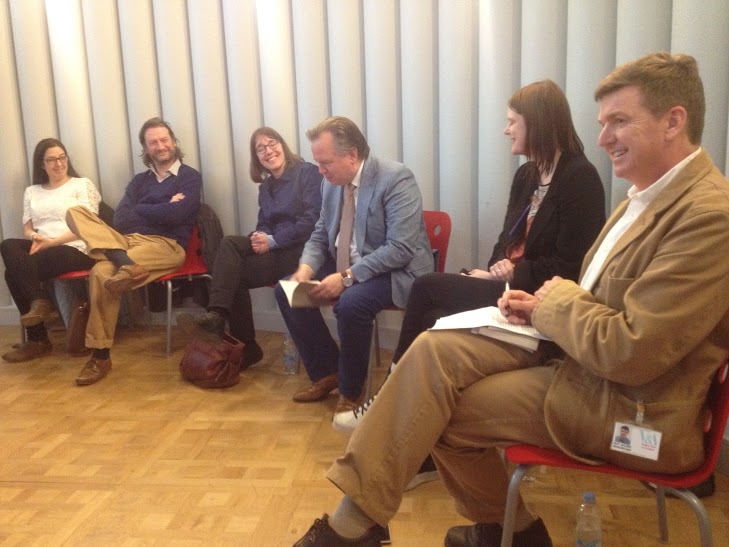
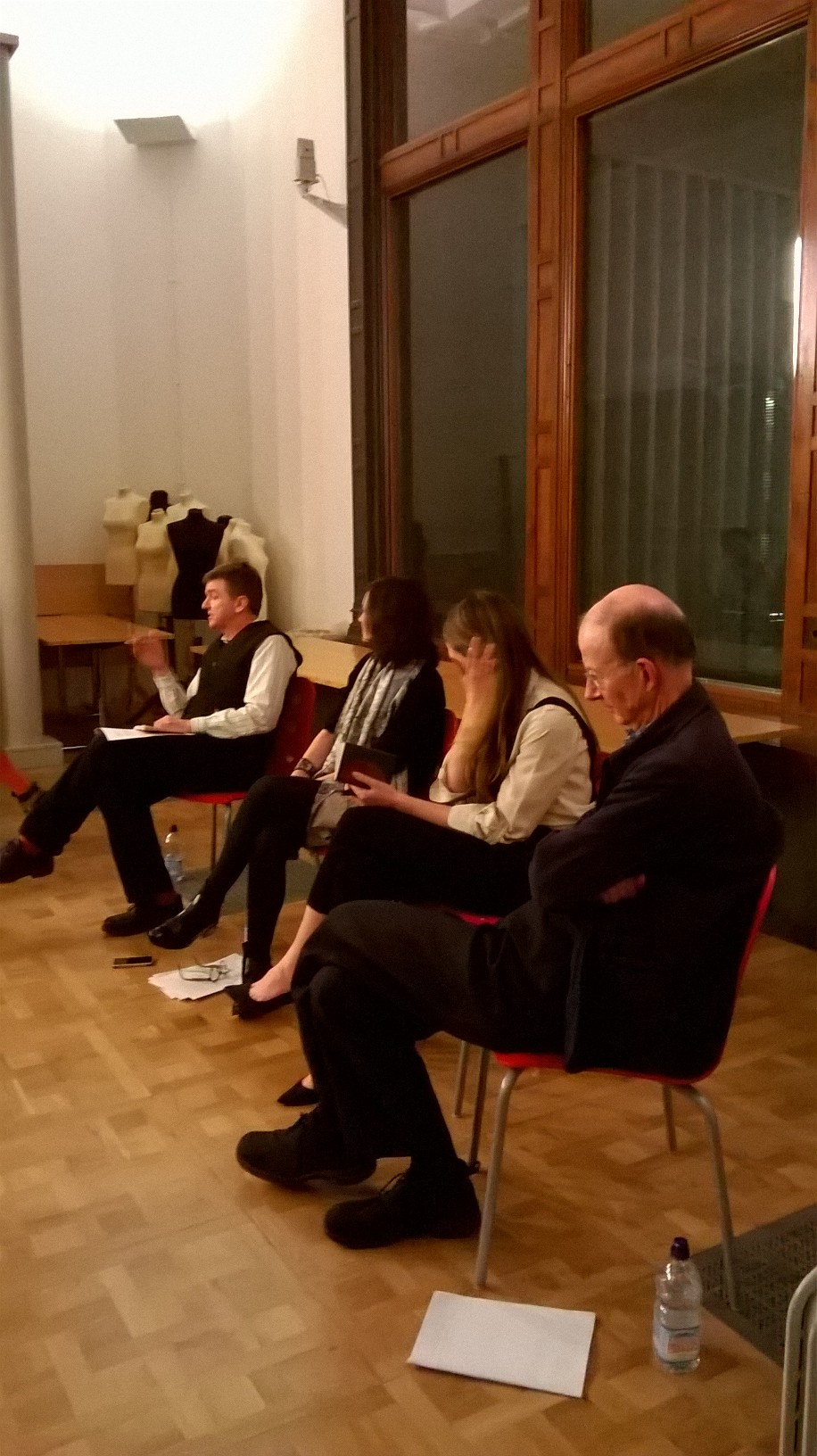
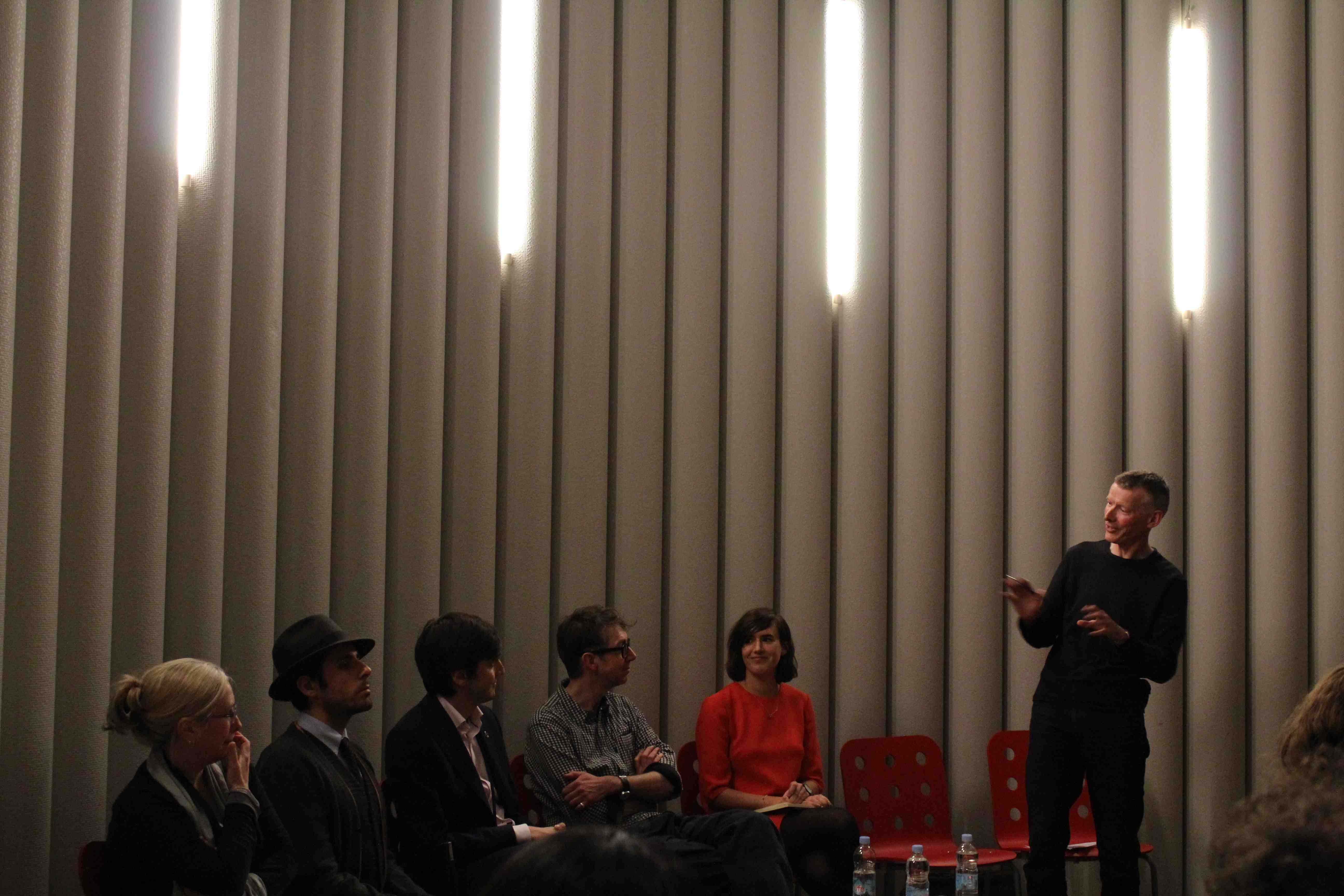
l to r:  Irenie Ekkeshis,  Gordon Hush,  Noortje Marres,  Barry Quirk, Leanne Wierzba, Guy Julier. Photo:  Jocelyn Bailey

l to r: Irenie Ekkeshis,
Gordon Hush,
Noortje Marres,
Barry Quirk, Leanne Wierzba, Guy Julier. Photo: Jocelyn Bailey

Irenie Ekkeshis also placed this turn toward the ‘consumer’ in the mid-1980s, arguing that consumer identity had dominated public discourse ever since. However, she noted this was, finally, being challenged. Digital technologies were allowing other possibilities of identity to circulate. As design has been partly responsible for getting us into this framework (‘another fine mess’), it can also be active in taking us to other sets of relationships and identities. Her work at the New Citizenship Project is focused on getting organizations and individuals to see through a citizen lens. For example, a new project of theirs is called Rabble; it finds ways of connecting families into volunteer activities and as such, it garners new possibilities beyond merely ‘going shopping’.

Gordon Hush put us right by arguing that notions of the consumer even went back to the seventeenth century. Aside from this correction, he also suggested that design itself can’t really do much for citizenship, but designers can. Citizenship as a concept is profoundly uneconomic in that it isn’t directed at maximum rent. So if designers look to working in this framework, then they have much to contribute but must look to other frameworks and ways of working. He cited the Scottish Parliament’s clear-sighted engagement with design methods, led by Cat Macaulay where policy is fostered by talking to people, visualising change and prototyping possible outcomes.

Noortje Marres challenged the separation of consumption and citizenship in the debate. These are not separate realms but are deeply entangled with each other, she argued. Design is, indeed, culpable in the process of giving these apparent autonomy. Once the consumer is disentangled from citizenship, then s/he is rendered unaccountable. (I take this to mean ‘alienated consumption’. Noortje cited Walter Lippmann’s 1922 book Public Opinion for its critique of the propensity to conceive of things like citizenship as somehow existing outside ‘normal’ or ‘everyday’ living. This takes politics out of ordinary activities. Design, according to Noortje, should and could be active in showing how politics and the quotidien everyday are entangled.

Barry Quirk began his intervention spectacularly by quoting Gracchus in Ridley Scott’s 2000 film Gladiator: ‘The beating heart of Rome is not the marble of the Senate, it’s the sand of the Colosseum’. With 250 days of circus at the height of the Roman Empire, entertainment prevailed over other concerns. There is another point here, though: the world of consumption is not entirely about the private individual – consumption is also a public activity. We vote to have influence over how the taxes we pay are spent, for example. Design, Barry argued, imprisons consumption in its own past. It structures and promotes modes of being rather than opening out new possibilities. How, conversely, can design work to promote empathy and social inclusion in systems of care?

Leanne Wierzba followed up on Barry’s observations on the dominance of consumer culture and its infantilizing effects by reminding us of Barbara Kruger’s 1987 work, ‘I Shop Therefore I Am’. Through this she took us to thinking about Jacques Lacan’s notion of the mirror stage and how ‘I organize myself in relation to the world out there’. Consumerism has become a dominant mode because it helps us position ourselves where other points of reference for the self seem to have faded or gone adrift. There is the possibility, though, that design can provide another mirror to help us look beyond the immediacy of the self-as-consumer and reflect back on the broader social, political, ecological and economic implications of this tendency in our culture.

The question as to whether design should be mobilized to make civic participation more attractive and more celebratory is challenging. At one level, the ‘pencil on a string’ mode of voting is dull; but it is also appropriately dispassionate, it could be said. Gordon Hush argued that we should disentangle politics from spectacle and allow a quiet space for us to think and engage in it, rather than ‘sexing-up voting paraphernalia’. Elsewhere, though, Noortje Marres saw the parallel in issues and brands: both are things that are enroled in; they draw in personal enthusiasm and concern.

Meanwhile, Irenie Ekkeshis sees a great opportunity lost with so much creative power amongst professionals and non-professionals alike when it isn’t mobilized more into the domain of citizenship. This can also come down to the way that choices are arrived at and Barry Quirk made the case for designers to be involved in developing more sophisticated forms of citizen participation in decision-making.

Leanne Wierzba brought up the eternal question of cost versus value here: currently, it is cheaper to maintain ‘old’ forms of citizenship (high consumption levels, high environmental impact etc.) than it is to derive new value in the social domain. The challenge, perhaps, is to design low-cost ways of achieving higher social and environmental value.

One of my current obsessions is refuting grandiose declarations of ‘design is this or that’. Can we have a more nuanced discussion where we are more precise about the kinds of design objects we are talking about, the economic frameworks in which design is functioning and the kinds of designers we mean? It seems to be one of the great immaturities of much design scholarship that it takes forever to get us beyond vapid generalisations. I was delighted that we began to talk about the different scales and materialities in which design, consumption and citizeship take place, therefore. These are different, for example, in the home, in the neighbourhood, in the borough or county or at national levels.

Citizenship is pegged to nationhood but may be active in various ways in different territorial conditions. (I refer you here to Doreen Massey’s excellent 2004 essay ‘Geographies of Responsibility’.) These may be brought into relation with one another, though. ‘How does a thermostat mediate climate change?’, Noortje Marres asked. The question perfectly entangles consumption and citizenship. But it also suggests that such everyday and intimate things can open up agonistic spaces where debate about our places in the world and the worlds we want can be activated.

Existential angst, folks, begins at home. But let’s get out there as well.


Guy Julier, 13 April 2015
 

Posted in citizenship, consumer culture | 1 Comment

Design Culture Salon 16: What does design do for citizenship in the age of the consumer?

Friday 10 April

6:30-8:30pm

Clore 55, British Galleries

Notions of the consumer and the citizen have become curiously entangled in recent years. In many cases, design has been the culprit in delivering this entanglement. Advertisements, branding and luxury lifestyle products increasingly conflate buying and consuming with individual agency on a variety of public issues, from climate change to online privacy. But how meaningful is this association? If design has been a powerful tool in merging notions of consumerism and citizenship, then how might it be used as a tool to reverse this? What other forms of citizenship are available to design with?

Chair: Guy Julier, Professor of Design Culture, University of Brighton and Victoria and Albert Museum.

Panel:
Irenie Ekkeshis, New Citizenship Project
Gordon Hush, Head of Product Design, Glasgow School of Art
Noortje Marres, Senior Lecturer in Sociology, Goldsmiths
Barry Quirk, Chief Executive of Lewisham Council
Leanne Wierzba, Winchester School of Art/V&A Research Fellow in Craft/Luxury

Irenie Ekkeshis started her career at leading London advertising agencies Lowe Lintas and Fallon London, working on clients including Unilever, Nokia, HSBC, BBC and Eurostar. She has worked on several innovative projects, including The Tate Movie Project, a collaboration with the Tate Gallery which harnessed children’s creativity to make a full-length feature film, and BBC jam, a free-to-access platform for children aged 5-16 to learn through interactive games. After a period running leading cultural tour operator The Traveller, and following major illness, Irenie became heavily involved in patient participation within the NHS and launched two innovative patient participation projects with Moorfields Eye Hospital and the National Institute of Health Research Biomedical Research Centre. In 2014 Irenie joined Jon to found the New Citizenship Project. In 2015 she was awarded Health and Social Care Campaigner of the Year by the Sheila McKechnie Foundation for her work to raise awareness of contact lens-related vision loss, following her own experience.

Gordon Hush is a Sociologist who now heads the Product Design department of The Glasgow School of Art. In addition, he oversees a suite of Masters programmes, including M.Des Design Innovation & Citizenship. He is not a fan of design as “nice things for rich people” but accepts that this is the world we live in. He tends to view design and its outcomes as a series of relationships between people and things and tries to explain this in terms of experience(s), since this avoids having to talk about human nature. He would like to see design figure as a means of re-distributing wealth and opportunity in our society, and remains curious as to whether it can truly do so.

Noortje Marres studied sociology and philosophy of science and technology at the University of Amsterdam and the École des Mines in Paris. She currently teaches sociology at Goldsmiths, University of London, where she convenes the Master’s in Digital Sociology and directs the interdisciplinary research Centre for the Study of Invention and Social Process (CSISP). Her work investigates relations between publicity, technology, and the environment by various means: social and political theory, digital methods, and in collaboration with artists and designers. Her first book, “Material Participation: Technology, the Environment and Everyday Publics” (Palgrave, 2012) was recently released in paperback, and she is currently writing a second: “Digital Sociology: the Reinvention of Social Research” (Polity).

Barry Quirk has been Chief Executive in LB Lewisham for over 20 years. He has worked in local government for more than 30 years, with service and management experience in five London Councils. He is  author of Re-imagining government: public leadership in challenging times (2011) and a frequent lecturer on public policy and management. Between 2006-8 he was the President and Chairman of SOLACE (the national association for local government chief executives). His 2013 Royal Society of Arts lecture ‘Design and Public Services: from soft furnishings to hard disciplines’ is available here.

Leanne Wierzba is a design historian, curator and writer. Her research investigates contemporary design practice and the culture of industry, focusing on luxury, digital fashion and speculative design. She is co-curator of What is Luxury? at the V&A and has co-curated a series of exhibitions on contemporary fashion at the Fashion Space Gallery, London College of Fashion. Previous experience as a fashion designer was gained working with notable brands in Vienna, New York, Paris and London. Her writing on fashion, design and contemporary culture has been published internationally.

Free event; All welcome!

This Salon coincides with the V&A exhibition All This Belongs To You.

Directions to Clore 55 here:

http://www.vam.ac.uk/digital/map/#l=2&r=facility_clore_study_area

Posted in Uncategorized | Leave a comment

Reflections on Design Culture Salon 15: How does design address immobilities in our society?

It is now 20 years since the Disability Discrimination Act (DDA) was passed into law in the UK. This made it an offence to discriminate against people with disabilities in the provision of education, transport, goods and services and employment. And yet, it is more complex than a piece of legislation when it gets actualized. Anyone with an impairment or who has accompanied someone with impairments will know that mobilities or immobilities are complex practices that are experienced in a variety of ways. Yes, it is about straightforward things like ramps and legibility. But it also encompasses nuances of language (as a recent edition of Myslexia reminds us), gendered notions of the body, institutional assumptions, the semiotics of materials and a huge range of questions that this Salon revealed.

In his introduction to the evening’s discussion, Rob Imrie reminded us that the subject for debate opens onto the politics of design. How society that is designed for and how society is engaged in designing itself provides a register for its priorities. What is considered to be mobility? For whom and how is mobility structured? These issues transform who we are. At the same time, impairment can be destabilized and in that, normative understandings of what this means can be challenged.

Rob Imrie (right) introduces the panel:  l. to r. Ana Carden-Coyne, Carmen Papalia, James Grant, Graham Pullin, Alison Thomson

Rob Imrie (right) introduces the panel: l. to r. Ana Carden-Coyne, Carmen Papalia, James Grant, Graham Pullin, Alison Thomson

In her opening position statement, cultural historian Ana Corden-Coyne drew on her research on war veterans of both World Wars. Following WW1, there were some 750,000 returnees who were categorized as disabled and in this environment war pensions were partly calculated on the basis lost body parts. This underlines a view of the body as an assemblage of parts, revealing the historical roots of the cyborg physique wherein lost parts could simply be replaced by prosthetics. In this, the body was conceived around a technological notion of hyper-masculinity. It followed from this that war would not be conceived as disabling; rather, the obstacles to rehabilitation were about ‘willpower’ and ‘attitude’. (In this, I am reminded of my childhood hero, Douglas Bader, as played by Kenneth More in Reach for the Sky; but much of its visual and rhetorical language is repeated in more contemporary representations such as via Help for Heroes.) Needless to say, there were resistances to this dominant system: many disabled veterans threw their unweildy prosthetics away. In this account, though, design has and continues to produce both cultural and social norms of disability that need unpicking.

This Salon was devised to coincide with the Shape Arts/V&A artist-in-residence Carmen Papalia‘s productive engagement with the museum. Carmen brings a wealth of experience in performances and enquiries that interface visual impairment with cultural institutions. It challenges the ocularcentricity of places such as the Victoria and Albert Museum by seeking out other channels for engagement. Carmen described how, for example, he has used a sighted companion to describe an art exhibition to him as another way of experiencing it. In this, he made a case for what he calls ‘open access’. This notion takes a fascinating turn from the ‘get round impairment’ school of design, curatorship or museology to challenge dominant, normative assumptions of experience. Open access means that a range of entry-points and registers can be made available and used. Smell, sound, touch, movement, vibration can all be folded into the embodied museum visit for all. Spaces are usually understood and encountered in many different ways, though we allow the visual to dominate. These observations were prefigured by Carmen’s discussion of his cane and how the white cane of the visually impaired became an institutionalising device for him. He has explored this through perfomances in which he has played with the cane to draw attention to its own cumbersomeness and that of the systems of intitutionalisation, or, in an even more spectacular way, by replacing the cane with a marching band as a device.

James Grant took the discussion into the important, pragmatic territory of how you address immobilities in a large provider organisation such as Transport for London (TFL). TFL manages the city’s tube, overground rail and bus systems, but also its red routes, traffic signals, cycle hire and congestion charge. Legislation, such as the DDA, sets the standard for what has been designed, but the pressure of campaigners has also been a positive force for TFL. Mobility, James argued, is at the sharp end of what a fulfilled life means, giving access, for example, to jobs, leisure, family and friends and so TFL is vital in this. Involving people with impairments in the design process is important in developing innovative approaches to information, infrastructure and customer services. Sometimes, though, this works on a very slow cycle: for instance, it takes 10 years between instigation, design, production and implementation of a new tube train design. There is a strong sense of TFL valiantly playing a constant game of ‘catch up’ as old infrastructure is incorporated into new systems or design developments and insights get actualized. Decision making runs from the micro-scale of information or device design through to strategizing the most effective points of intervention across an infrastructure.

Citing the example of Charles and Ray Eames’s explorations in plywood splints during WW2, Graham Pullin opened out the beneficial transfer of design ideas between domains of design. The Eames’s work for the military fed into design for volume production furniture such as the Model DCW chair. Graham’s personal story was that he left work as a product designer at IDEO to pursue a fascination with speech. He explored issues such as embedding emotion into speech technologies. Likewise, he asked what if we regarded a prosthetic hand really as a hand rather than merely as a tool? How, for instance, would we embed the emotional language of gesture into it? In this he is going beyond the mere ‘design as problem-solving’ notion to pose new questions and speculations that exist on the boundaries, or outside the frame, of institutionalised, received understandings. Can we go further, he later asked, in designing for appropriation? This might be where those with impairments can take on the fashioning and development of objects and environments to suit their needs or wishes.

Continuing in a similar vein, Alison Thomson made the case for designers to focus on issues rather than objects. She sees her role and that of other similarly minded researchers and practitioners in what the sociologist Mike Michaels has called ‘inventive problem making’, to reveal previously unthought-of pathways to conceptualizing and addressing immobilities. If, at times, there is a ludic approach here, where play, imagination and disruption play prominent roles in the process, then this distances design from its traditional role in attempting to ‘solve problems’ and, even, just ‘make things work in a be-grudging way’. I think that there can sometimes be a kind of worthiness in designing with disability that results in clunky responses to everyday challenges and, worse still, continues to medicalise impairment. Impairment is sometimes seen as ‘something that can be solved’ rather than something to be explored, engaged and enthusiastically embraced.

This is not to belittle straightforward access issues and, indeed, several comments and questions from audience-participants returned to this. At one level, this concerned very specific issues such as the design of overground or tube stations or the interiors of buses. But sometimes priorities have to be decided. James Grant drew attention to the challenge of needing to take strategic decisions in giving attentioin to certain locations over others in public transport. Hence, for example, the extra complexity of making a fully accessible station (Green Park) that was also a hub for shopping and leisure was worth taking on as against smaller-scale interventions. At another level, though, accessibility is also about the emotional experience of a space. Accessible toilets, observed Tony Heaton, Director of Shape Arts, can often be depressingly barren — lacking in any of the humour or delight that they should incorporate. Tony’s hot tip for hotels that provide amazing access in this respect is the Melia Hotel in Berlin, by the way.

Access is about step-free environments. But it is also about emotional access. As Rob Imrie argued, it should go beyond a box-ticking exercise on an access statement to incorporate a wider range of modalities. It functions at the symbolic in terms of giving recognition to all participants in a situation. A wheel-chair ramp is a slope but it is also a declaration. We were honoured to have Amanda Cachia from the University of San Diego in the audience. Amanda spoke of how she takes her own portable podium to the public lectures she gives and assembles it as part of the performance. Through she gets the scale of the environment to adjust to her atypical height rather that the other way around. Her podium thus becomes an assertion of selfhood as much as some thing to rest her laptop on.

This Salon again demonstrated the richness to be derived in combining participants from a wide variety of backgrounds on a panel. The conversation ranged from the most speculative to the most everyday. While it drew in a few faithful regulars, as ever the theme brought in specialists amongst the audience-participants. We covered a full two hours of discussion and could have gone on.

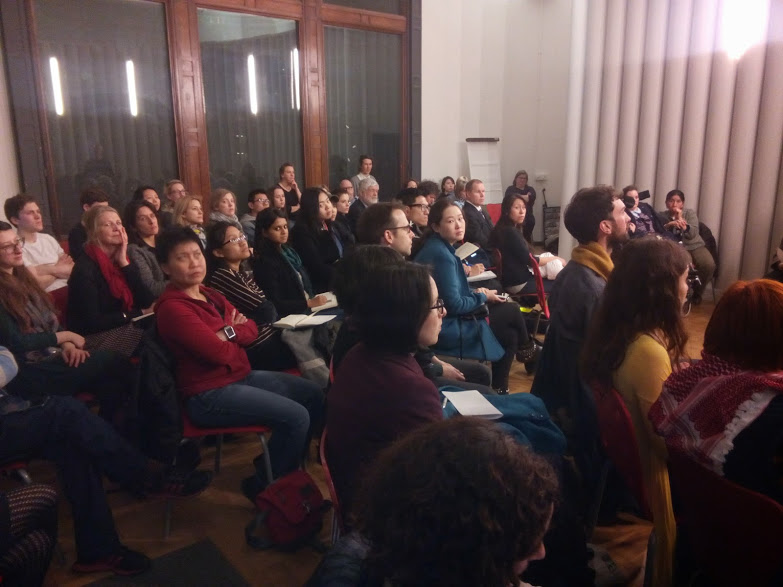
Friday night and a capacity audience

Friday night and a capacity audience

Ultimately, as Graham Pullin stated, design is bigger than designers. This neatly sums up what we’re trying to get to with these Salons. By calling them ‘Design Culture Salons’ we want to reach beyond the notion that design is just done by creative professionals. It is practised in all kinds of ways: in management decisions, policymaking, media representation, specification and commissioning, and in our everyday engagements in the socio-material world. By clustering our attention around a specific issue — such as immobilities — we can begin to trace the relationships and sinews between the material and human constituents that produce, control or disrupt it operations. But I also hope that design culture is seen as something that is dynamic rather than static and that through discussing it we can also open up ways by which we can intervene on it.


Guy Julier, University of Brighton/Victoria and Albert Museum

19 March 2015


Posted in immobility, mobility | Tagged , , , , , , , , , | Leave a comment

Design Culture Salon 15: How does design address immobilities in our society?

Friday 13 March

6:30-8:30pm

Clore 55, British Galleries

While Design Culture Salon 10 looked at the concept of movement in urban culture, this salon focuses on spaces of immobility to reveal some of the inconsistencies and resistances in contemporary design culture. Bodies of the disabled, ill and elderly are difficult to find in design history, while contemporary design is often more eager to engage in idealized forms of engineering the urban mobile citizen. So, how can the enabling capacities of design be improved? What are the challenges and obstacles here? How can they be overcome? What can designers learn from cultural theories and histories of the representation of the body and from a wider reading of disability studies?

Chair: Rob Imrie, Professor of Sociology, Goldsmiths, London

Panel:
Ana Carden-Coyne, Co-Director of Cultural History of War, University of Manchester and author of Reconstructing the Body
James Grant, Senior Communications Manager, Transport for London
Graham Pullin, Course Director of Interaction Design at the Duncan Jordanstone College of Art, University of Dundee and author of Design Meets Disability
Carmen Papalia, V&A and Adam Reynolds Memorial Resident, in partnership with Shape
Alison Thomson, PhD Candidate, Goldsmiths, London

Professor Rob Imrie (Chair) is Professor of Sociology at Goldsmiths, London. He has a background is in geography, sociology, and planning studies and he has a doctorate in industrial sociology. He was previously Professor of Geography at Kings College London and at Royal Holloway University of London, prior to that.
In 2004, Rob was awarded the ‘Back Award’ by the Royal Geographical Society (with the Institute of British Geographers), in recognition of ‘contributions to research on national and local policies in urban development and local governance’, June 14th. Between 2003 and 2007, Rob was visiting professor, Department of Geography, University of Strathclyde. He has since held visiting professorships in the Urban Research Centre, University of Western Sydney (2008), and the Department of Applied Social Studies, University of Cork (2009). He is a former member of: the Department of Communites and Local Government’s (DCLG) Working Party advising on changes to Part M of the Building Regulations; the DCLG’s Housing Research Network, with responsibility to develop links between housing research and policy; and, the Lifetime Homes Group, Joseph Rowntree Foundation. He is an editorial board member of the ‘Access Journal’.

Dr Ana Carden Coyne is co-Director of the Centre for the Cultural History of War (CCHW) at the University of Manchester, in the School of Arts, Histories and Cultures. She has recently co-curated a centenary WW1 art exhibition for the Manchester Art Gallery, The Sensory War, 1914-2014 (Oct 2014-Feb 2015) engaging over 200,000 visitors. Her latest book The Politics of Wounds: Military Patients and Medical Power in the First World War examines the logistics of transport and medical evacuation through the eyes of patients, the impact of surgical experimentation, the short-lived but intimate social relations of hospital life, and the reintegration of disabled soldiers after the war. In Reconstructing the Body: Classicism, Modernism and the First World War (Oxford University Press, 2009) she examined the impact of war on culture and society as an embodied phenomenon. In Gender and Conflict Since 1914: Historical and Interdisciplinary Perspectives (Palgrave, 2012), scholars from the humanities and social sciences consider the impact of war on gender roles in the past and present. She also co-edited a special edition on disability, ‘Enabling the Past’, for the European Review of History (2007). Carden-Coyne is on the steering committee for Disability History Month in Manchester, and has contributed to other international events, the Sydney Festival photography exhibition ‘Exposed’, and the Queer Thinking Day for the Sydney Gay and Lesbian Mardi Gras. The Guardian newspaper published her WW1 commemorative booklet on ‘Wounded Visionaries’.

James Grant has worked for Transport for London since 2009 and has for the past three years led its communications around accessibility and inclusion. James is responsible for TfL’s engagement with older and disabled people’s organisations and is closely involved in accessibility policy development. He works to ensure the organisation’s plans meet the needs of disabled customers and stakeholders and that their voices are heard within major projects and change programmes. James is a champion of innovation and has helped charities and technology firms trial new systems to help people access the transport network, including the recent Wayfindr trial of Bluetooth technology to guide visually impaired people through stations. In 2014 he organised the largest transport accessibility event the UK has held, bringing together 1,500 customers and stakeholders with managers, planners, designers and operational staff from across the Capital’s networks for a conference and exhibition at Excel London.

Graham Pullin is Course Director, Digital Interaction Design, Duncan Jordanstone College of Art and Design (DJCAD). His manifesto Design Meets Disability (MIT Press, 2009) argues for more art school–trained designers to be invited into disability-related design, in order to contribute not only their skills but also their sensibilities. Don Norman described it as “a powerful, important book”. He is Senior Lecturer in Interaction Design and Product Design at the University of Dundee, where his research is pioneering more expressive communication for people who cannot speak, through projects such as Six Speaking Chairs and his PhD 17 ways to say yes. He is also exploring radical new materials for prosthetic hands: materials that do not imitate human skin, but are instead chosen for their aesthetic qualities or cultural resonances. Previously, Graham was a studio head at the design consultancy IDEO, leading multidisciplinary teams on projects as diverse as commercial mobile phones for people in their 50s, concept hearing–enabling furniture for the V&A Museum, London, and the critical design project Social Mobiles, exhibited at MoMA.

Carmen Papalia is Adam Reynolds Memorial Designer in Residence, Victoria and Albert Museum. Born in Vancouver, Brittish Columbia in 1981, Carmen Papalia is a Social Practice artist who makes participatory projects  on the topic of access as it relates to public space, the Art institution and visual culture. His work has been featured as part of exhibitions and engagements at: The Solomon R. Guggenheim museum, the Museum of Modern Artt in New York, the Whitney Museum of American Art, the L.A Craft and Folk Art Museum and the CUE Art Foundation among others. Papalia is the recipient of the 2014 Adam Reynolds Memorial Bursary and the 2013 Wynn Newhouse Award for artistic merit in contemporary art. He holds a Master of Fine Arts in Art & Social Practice from Portland State University and a Bachelor of Arts in English Literature from Simon Fraser University. His recent writings can be found in: Stay Solid: A Radical Handbook for Youth (AK Press, 2013), in his Reference Points monograph on the Chicago-based collaborative Temporary Services (Publication Studio, 2013), in the ‘Museum Experience and Blindness’ issue of Disability Studies Quarterly and most recently in the ‘Publics’ issue of Art21.

Alison Thomson is a Designer and PhD Candidate, Goldsmiths, University of London. In 2008 Alison graduated from Interactive Media Design at the University of Dundee where she worked with local community in exploring the meaning of ‘human connectedness’ through design-led research. From here she went on to complete an MA in Design Interactions at the Royal College of Art where she first collaborated with Professor Gavin Giovannoni and the Neuroimmunology Group at Queen Mary, University of London. Her practice-based PhD explores how design-research can re-do ‘the patient experience’ considering the multiple realities of Multiple Sclerosis and its ontological politics. A core empirical part of this involves working as a Visiting Researcher with the MS research team at the Blizard Institute, Queen Mary, University of London. Through using performative design-led interventions, the research is uncovering the various ontologies of Multiple Sclerosis at play in the outpatient clinic at The Royal London Hospital, in the Neuroimmunology Group at the Blizard Institute and at international scientific conferences. This practice-based research hopes to expand on the potential implications for design research in studying enactments of MS through proposing alternative service interactions.

Free event; All welcome!

Directions to Clore 55 here:

http://www.vam.ac.uk/digital/map/#l=2&r=facility_clore_study_area

___________________________

Posted in Uncategorized | Leave a comment

Design Culture Salon 15: How does design address immobilities in our society?

Design Culture Salon 15: How does design address immobilities in our society?

Friday 13 March
6:30-8:30pm

Clore 55, British Galleries

While Design Culture Salon 10 looked at the concept of movement in urban culture, this salon focuses on spaces of immobility to reveal some of the inconsistencies and resistances in contemporary design culture. Bodies of the disabled, ill and elderly are difficult to find in design history, while contemporary design is often more eager to engage in idealized forms of engineering the urban mobile citizen. So, how can the enabling capacities of design be improved? What are the challenges and obstacles here? How can they be overcome? What can designers learn from cultural theories and histories of the representation of the body and from a wider reading of disability studies?

Chair: Rob Imrie, Professor of Sociology, Goldsmiths, London

Panel:
Ana Carden-Coyne, Co-Director of Cultural History of War, University of Manchester and author of Reconstructing the Body
James Grant, Senior Communications Manager, Transport for London
Graham Pullin, Course Director of Interaction Design at the Duncan Jordanstone College of Art, University of Dundee and author of Design Meets Disability
Carmen Papalia, V&A and Adam Reynolds Memorial Resident, in partnership with Shape
Alison Thomson, PhD Candidate, Goldsmiths, London

Free event; All welcome!

Directions to Clore 55 here:

http://www.vam.ac.uk/digital/map/#l=2&r=facility_clore_study_area


Posted in activism, age, citizenship, immobility, mobility | Leave a comment

Reflections on Design Culture Salon 14: How dependent is the design profession on cultures of migration?

Salon panel furthest from camera: Guy Julier (Chair), Alison Clarke, Melissa Clark and Robin Kinross.

Salon panel furthest from camera: Guy Julier (Chair), Alison Clarke, Melissa Clark and Robin Kinross.

How dependent is the design profession on cultures of migration?

As regular attendees will know, the Design Culture Salons have had a distinctly ‘mobile’ feel of late. Physically, this has involved a migration across the museum from our previous home in the Sackler Centre, South East of the museum (temporarily closed during Exhibition Road excavations) to the more intimate location of Clore 55, a circular room in the north-eastern corner. And like the room itself, thematically this series seems to have been preoccupied with concepts of circularity, from cycling to fashion cycles and the designer’s career cycle. So, it was in keeping with this general theme (and with political dialogue in the run up to the election) that we hit on the topic of migration to ask, ‘how dependent is the design profession on cultures of migration?’

Introducing things, Professor Guy Julier described the great legacy of émigré design culture that has underpinned the profession in Britain since the post-war period. He questioned whether this legacy had created a mythological status on the value of cultures of migration in design or whether there was something structural, practical even, about the relationship between migration and design practice. To test the case, Guy asked the audience to raise their hands if they identified as migrants. Roughly two thirds of the audience arms were raised. The topic certainly had an engaged audience.

The first to speak was Melissa Clark of Method design consultancy. Melissa spoke of the importance of the culture of migration to both Method as a brand and as a team, remarking upon the diversity of its workforce, which represents over sixteen different nationalities in the London office alone. Being able to capture the value of this diversity is a key part of the design process, she argued, and is a valuable asset when dealing with corporate international clients, from McDonalds to Nokia. However, she also stated that it was important not to be complacent about this diversity. She was aware of the privilege in being situated in one of the most densely populated areas of the global creative economy, the ‘Shoreditch silo’. This ‘global view’ is a particular, rather than a universal one.

Alison Clarke, Professor of Design History at the University of Applied Arts, Vienna described her own migration to the field of design history via anthropology and ethnography. One of her first major contributions to the field was in her study of glassware company Ysart, where she paid attention to Pablo Ysart’s journey from Barcelona to France to Scotland as an integral rather than incidental aspect of his identity and formed a tension throughout his work. Similarly, reading Raymond Loewy’s 1951 biography ‘Never Leave Well Enough Alone’, Clarke was struck by the revulsion Loewy continually identifies for American food- a fascinating point to consider in relation to his work there. Nevertheless, Clarke put the point that these personal ‘journeys’ need to be carefully considered before making connections with professional practice. There are careful distinctions and demarcations that need to be made in relation to émigré culture and identities. ‘They are often borne from different modes of displacement’, she said. In particular, a distinction should be made between political and economic displacement and cosmopolitanism. Clarke’s contribution reminded us that questions of identity are always fragile and in a constant state of formation rather than fixed according to the cultural categories of ‘émigré’ or migrant.

Robin Kinross, founder of Hyphen Press and design historian, the final speaker for the evening, brought a vital perspective to the topic as someone involved in the first wave of writing émigré design history in the late 1980s. Personally, he explained, his own interest in design was about ‘finding a way out of the UK’- a journey which brought him into contact with those who had found themselves here, having arrived from elsewhere. He spoke about the practical issues that equipped émigré designers with a specific skill-set, such as the Imperial metric system and being able to communicate in multiple languages. For him, these were indicators and facilitators of a broader ‘European’ mind-set. In this sense, it put these particular emigres (including FHK Henrion and Anthony Froshaug) in a position of privilege rather than vulnerability. He further extended upon Alison’s point about the significance of fully appreciating the circumstances for migration, be they political, economic or otherwise. For him, the issue of cosmopolitanism, was, for Kinross, something quite different to the ‘damaged lives’ of those fleeing the Second World War.

Prompted by Guy, the salon panellists then entered a discussion about some of the key features of ‘émigré’ design culture, including the difference between ‘travel’ and migration and the notion of privilege which is evident among many of the European designers in the formative years of the profession. The discussion also took in aspects of design ‘etiquette’ (with clients and with each other) and the extent to which this is moulded by cultural beliefs and values.

From here, and opening up to the audience, the conversation was rich and covered a wide range of topics, including power and technology. One member of the audience spoke about the materiality of émigré design culture we live with every day in the architecture of London and asked about the extent to which this process of risk and experimentation can be identified today. One barrier to this might be planning laws, for example, which are often culturally rooted and difficult to navigate as an ‘outsider’. The notion of ‘hustling’ was briefly considered as a valuable trait of the migrant designer.

A student in the room described the vitality of studio culture as an interesting example of a site in which the migration of ideas, people and diverse backgrounds meet and are negotiated in the art school. In her case, there are sixty students in her design course at Goldsmiths, representing a total of 20 different nationalities. In this sense, the studio can be viewed as an ‘incubator’ for the structural and cultural features that currently animate our creative economy.

Another audience member was less optimistic. While the design profession might be culturally diverse, its output has never looked ‘more boring’. A generic westernised cosmopolitanism now dominates client briefs and imposes an increasingly generic ‘global’ image of design practice. Examples from those in the room who had recently worked for or collaborated with clients in China, Taipei and the Middle East, confirmed this suspicion: the very act of ‘travelling’ or ‘moving’ in design doesn’t necessarily equate with the migration of ideas, or indeed, inculcate a culture of innovation.

As Guy stated, there seems to be a ‘soft side’ and a ‘hard side’ to the conversation. In this sense, we were missing the contribution of economist Max Nathan, who regrettably had to withdraw from the panel at last minute.

By the end of the Salon, several members of the audience were pushing for a closer convergence in the fields of anthropology and design research. As in previous Salon conversations, there was a healthy dose of cynicism in the air, as people pointed to what appear to be fixed and immobile features of design culture. Robin Kinross, for instance, spoke of the very limited age bracket that continues to define the graphic design profession, (picking up on last month’s salon topic). Therefore, while it is common to talk about design as a migratory, mobile and dynamic practice, the Salon ended by reflecting on the points of resistance within this. In this sense, what started as a conversation about migration came full circle and recurring issues, identified previously in the series, re-surfaced.

Dr. Leah Armstrong, Unviersity of Brighton / Victoria and Albert Museum

The next design culture salon is taking place on 13 March at 6:30pm in Clore 55, V&A Museum. The topic is ‘How does design address immobilities in our society?’

It is free and all are welcome.

Posted in Uncategorized | Tagged | Leave a comment

Design Culture Salon 14: How dependent is the design profession on cultures of migration?

Friday 20 Feb 6:30pm-8:30pm Clore 55, British Galleries, Victoria and Albert Museum

Immigration has been a bargaining point between the political parties in the run up to the 2015 election and can be seen to particularly divide attitudes to working cultures in the UK. Economic experts point to the vital and invigorating role immigration plays in our national economy. Design historians have established that the UK profession was carved out by émigré designers. Sociologists and geographers continue to note the lasting and continuing importance of global cultures of design in shaping the UK creative economy. Design Culture, as a research discipline, studies the migration of ideas, cultures, aesthetics and styles as well as practices and people. Building on these perspectives, this Design Culture Salon asks the following questions: Does migration mean something particular and distinct in design? If designers are in the business of innovating and instigating change, is it an advantage for the designer to be an ‘outsider’? Or even further, is the designer necessarily an outsider? Could the design profession exist without these cultures of migration? Is the identity of the migrant or émigré an anachronism in an increasingly global design economy?

Chair: Guy Julier, Professor of Design Culture, University of Brighton and Victoria and Albert Museum.

Panel:

Robin Kinross is a typographer, writer, and editor. In the 1970s he did postgraduate research on the work of Otto and Marie Neurath and has since maintained an interest in the emigration of the 1930s from Central Europe to the UK. In 1980 he started Hyphen Press, which publishes books on design and related subjects. His own books include Modern Typography, Unjustified Texts, Anthony Froshaug: Texts and Typography / Documents of a Life, and many essays and articles on typography and graphic design.

Alison J Clarke is Professor, Design History and Theory & Director, Papanek Foundation at the University of Applied Arts Vienna whose forthcoming international biennial symposium, Émigré Design Culture: Histories of the Social in Design (2015) addresses the legacy of émigré histories in progressive design. As a design historian (RCA/V&A) and social anthropologist (UCL), Clarke specialises in histories and ethnographic research concerning the politics and social relations of design and material culture. A former Smithsonian Fellow, she is author of Tupperware: The Promise of Plastic in 1950s America (made into an Emmy-nominated documentary) and Design Anthropology: Object Culture in the 21st Century. She is co-founder and editor of inter-disciplinary journal Home Cultures: Architecture, Design and Domestic Space. Alison presently directs a major funded research project “Émigré Cultural Networks and the Founding of Social Design” (FWF: Austrian Science Fund), and is completing a related monograph with MIT press titled Design for the Real World: Legacies of Radical and Activist Design.

Max Nathan works at NIESR and at LSE, where he is a Deputy Director of the What Works Centre for Local Economic Growth and a Research Fellow at the Spatial Economics Research Centre. His research looks at the economics of migration and diversity, innovation systems, and public policy for cities. Max has over 12 years’ experience working in UK think tanks, consultancy and public policy. Most recently he worked at the Department of Communities and Local Government as an ESRC-DCLG Senior Policy Adviser, covering a range of economic development and governance issues. In 2004 Max co-founded the Centre for Cities think tank, where he ran the research programme. He is an Associate at the Centre for London and the Institute for Public Policy Research, and a Research Fellow at IZA. 

Melissa Clark is Client Service Lead for the experience design firm Method, and has ‘nearly’ a decades experience leading and delivering customer insight, strategy, marketing and optimisation projects for international clients across sectors. A born and bred Londoner, she started her career at a boutique strategic consultancy to help clients realise the power of digital. Wanting to be closer to the action, she then decided to join the design world because she saw an opportunity to better bridge the gap between working out what to make and then making it. Curious, playful and colourful, she works with both her clients and team to deliver projects that make a difference, and continue to push boundaries. Her work has touched audiences in over 23 countries and in over 14 different languages. To date, she has been featured in Design Week, Fast Company, Creative Review, Wired Design.

Free event: All welcome! Directions to Clore 55 here: http://www.vam.ac.uk/digital/map/#l=2&r=facility_clore_study_area

Posted in Uncategorized | Leave a comment

Reflections on Design Culture Salon 13: How does age influence cultures of design?

Design Culture Salon 13: How does age influence cultures of design?

Contemporary design culture seems to be in a constant state of anticipation, on the look-out for the ‘next big thing’. The design media frequently compiles lists of the ‘ones to watch’ through which they promote the culture of ‘beginnings, creativity and risk’, the tagline of new magazine The Great Discontent. Here, design celebrates the young.

However, an alternative image and function for design has been nudging into view lately. Selfridges is celebrating ‘Bright Old Things’ and fashion design is finding its muse in a notably older generation. Likewise, many of the discussions which have taken place in previous Design Culture Salons have been interested in winding down or interrupting the intense speeds at which we are accustomed to talking about design. They seem to have suggested a more considered, responsible function for design discourse- whether through design philosophy, policy making or permaculture.

So what does this tell us about the relationship between age and design culture? What priorities and privileges does it reveal in our social values? How helpful or misleading is this correlation between age, innovation, creativity and design?

Salon number 13 acquired an entirely unexpected energy due to the fact that three of the panelists – Joe Smith, Laura Jordan Bambach and Lynda Relph-Knight- had all, for different reasons, been forced to cancel on the day. We were extremely lucky to bring in two fantastic replacements- designer Alasdair Scott and artist, activist and many other things, Susan Benn. Both seemed to encapsulate the qualities we were seeking to unpack and examine in this Salon, bringing a wealth of experience which cut across creative, artistic and design practices.

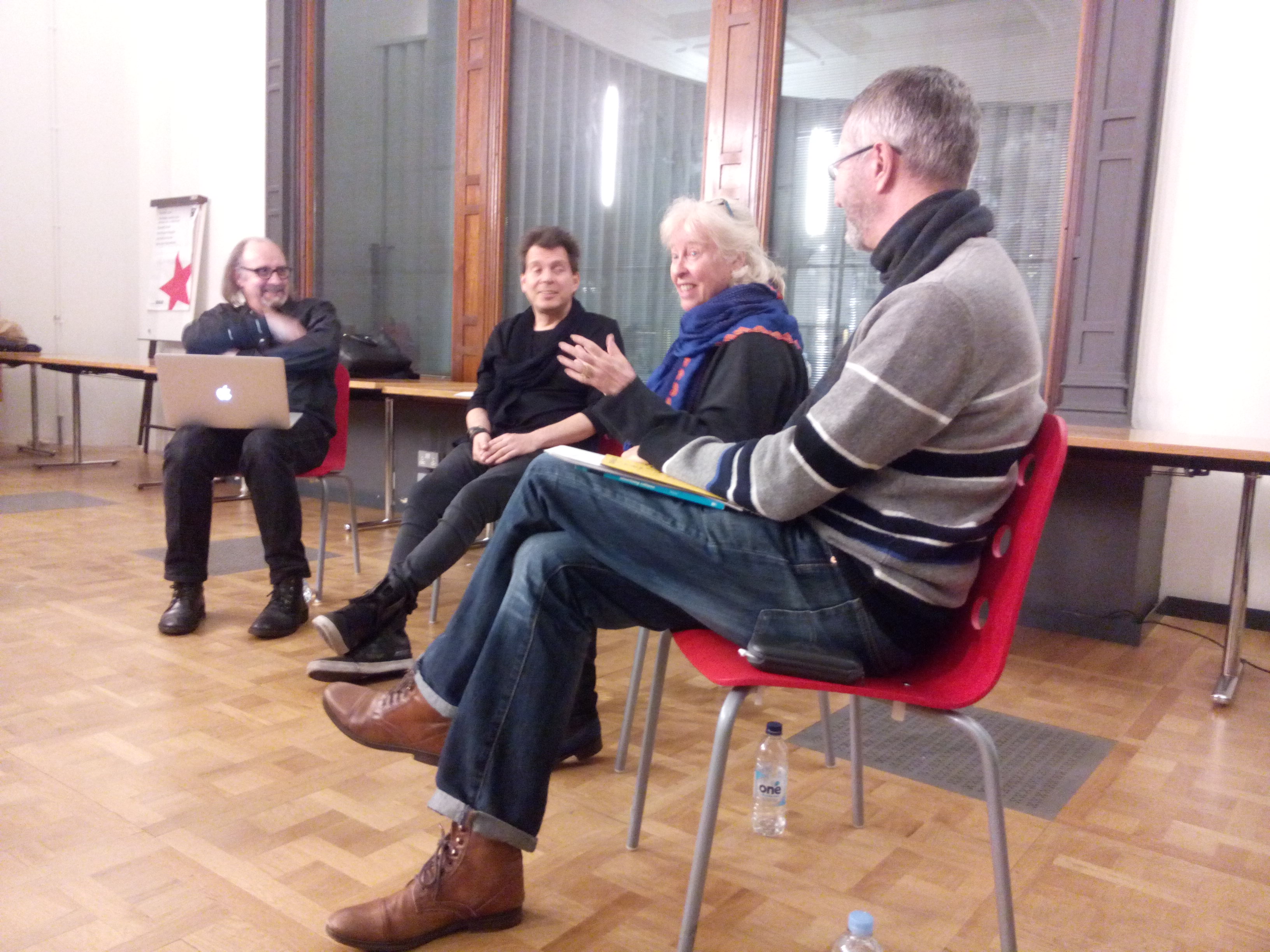
Salon 13 panel: Left to Right: Malcolm Garrett RDI, Alasdair Scott, Susan Benn and Sean Nixon

Salon 13 panel: Left to Right: Malcolm Garrett RDI, Alasdair Scott, Susan Benn and Sean Nixon

Malcolm Garrett, chair for the evening, was also ideally placed to speak about this issue. In his introduction, he reflected on his own career trajectory- describing the transition ‘from student to master’ (Malcolm is Master of the Faculty of RDIs at the RSA). Malcolm’s early career was also strongly shaped by his association with the late 70s music scene in Manchester and the punk movement aesthetic. Being part of a ‘generation’ has clearly played an important function in his career.

To start things off, Malcolm asked Alasdair Scott to reflect on how things have changed over his career and how he thought age has impacted the direction he has gone. In his response, Alasdair raised the significance of technological advancements, which shape the medium through which a ‘generation’ can find its voice. Expanding on this, he also made the important point that cultures of age are, of course, contingent upon social and economic conditions. When we talk about ‘age’, we are really talking about history. This might be used to make sense of the ‘being in the right time, in the right place’.

Professor Sean Nixon probed a little further into this theme. He was well placed to do so, since much of his work has focused on the lifestyles, attitudes and behaviours of those working in advertising. Here, he argued, youthfulness is valorized and celebrated above all else. This is not only visible in the emphasis on ‘creativity’ and ‘New Blood’ pushed by institutions such as D&AD, but also in the demographics of the industry, which puts the average age at 34. This fascination with youth is problematic, not least because of the limited capacity for representation it offers. It is, however, a central component of the ‘myth making’ that goes on in these industries, which presents creativity as a ‘moral imperative’.

Next to speak was Susan Benn, whose work in founding the PAL Labs has brought her into contact with a wide range of artistic practices and age groups. Malcolm asked her how she had managed to sustain her youthful energy throughout her varied career. Susan said she had always resented the very notion of growing up and has, throughout her life, felt that whatever the problem, the ‘grown-ups have got it wrong’. For her therefore, the idea of being a ‘grown up’ was an attitudinal, rather than an age-related, issue. The fixed priorities of older generations can be stifling for young people in the fields of art, design and film. People rarely stop to ask the young ‘what do you care about?’. Susan also criticized the invention of words such as ‘creativity’, ‘collaboration’ which try to mechanise and formalize what is essentially natural human behavior.

The conversation flowed, moving through several themes, including the function of design awards as a ‘rite of passage’, (or perhaps ‘rite of consecration’, as Pierre Bourdieu would have it), in design. Alasdair noted that he used to receive awards, now he gives them out- that’s a marker of age. The discussion also veered at times into the ‘myth-making’ Sean had described. Malcolm and Alasdair reminisced about the ‘good old days’ in Shoreditch, when they were the first graphic design company to set up on Curtain Road (an area now pulsing with this sort of activity). However, Alasdair also bravely made the point that his own generation, the 40-something, has stubbornly clung to their youth, to the extent that younger generations now have to be ‘more extreme’ to represent youth culture.

The question of risk also became a major discussion point. Malcolm asked the audience, which was composed of many young students, to reflect on the last time they had taken a risk. There was a prolonged silence. One student from Goldsmiths admitted that people of her generation were consciously risk-averse. Guy Julier reminded us that Joe Smith, the youngest panelist on the original Salon line-up, had to cancel the last minute because of a meeting with his accountant! Time and money appear to be luxuries more freely available in previous generations.

Some students sitting in the front row said that their overwhelming attitude was one of fear and anxiety for the future and their place in it. They feel a great weight of social responsibility on their shoulders, rather than the youthful naivety and confidence Malcolm had described in his introduction. ‘It’s too late’, they said, ‘We feel that we don’t have enough time’.

Malcolm agreed that this was one of the most profound shifts he had identified through his work with the RSA. ‘Whereas we in the punk movement just wanted to change things, young designers today want to change things for the better’. It’s a great quote that neatly summarised the social imperative that now drives design culture.

So, this Design Culture Salon was notably different in tone from the others, as it became something closer to a conversation between two generations- the student and the master- to go back to Malcolm’s description. Some of the greatest sense of responsibility and ‘wisdom’ appeared to be coming from the youngest in the room. There is something very profound about this inversion- or perhaps, as Susan argued, it has always been this way. It was a sobering moment and certainly left me with much to mull over.

Dr Leah Armstrong

University of Brighton / Victoria and Albert Museum

Posted in age, design education | 2 Comments

Design Culture Salon 13: How does age influence cultures of design?

Friday 9 January 2015
6:30pm-8:30pm

Clore 55, British Galleries
Victoria and Albert Museum

Creativity; intuition; innovation; experimentation: these words commonly punctuate design narratives in practice, research and in the media. They are also all, interestingly, most associated with youth culture. The designer’s career cycle appears to move in new directions with age. Design institutions such as D&AD promote the dynamism of the ‘new generation’ through its ‘New Blood’ scheme. So, what does this tell us about the relationship between age and design culture? How meaningful is this generational view of design practice? How is the career narrative of the designer framed in relation to cultures of age? To what extent is design a youthful skill, characterized by intuition and innovation, or is there a place for ‘design wisdom’ in contemporary society?

Chair: Malcolm Garrett, Graphic designer and Master of the Faculty of RDIs

Panel:

Professor Sean Nixon, Head of Sociology, University of Essex

Joseph Smith, Designer, Artist and Co-Founder of Makerversity

Alasdair Scott, Partner at C3UK

Susan Benn, Founder and President of Performance Arts Labs (PAL ltd)

This event is free, but booking is required.
To join the guest list, please contact Leah Armstrong (l.armstrong[at]vam.ac.uk)

Sean Nixon is Professor and Head of the Department of Sociology at the University of Essex. He has published extensively on the subject of advertising, the cultural economy and creativity. His most recent publications include Hard Sell: Advertising, Affluence and Trans-Atlantic Relations circa 1951-69 and in 2013, he co-edited the second collection of Representation: Cultural Representation and Signifying Practices with Stuart Hall and Jessica Evans. He is currently working on an Australian Research council funded project with colleagues at the University of Melbourne, UWS and Brown University. It explores the exporting of American advertising practices and techniques to Australia in the late twentieth century. It will focus the mediating role played by British advertising in this transfer of knowledge and expertise between the ‘advanced’ world of American advertising and the subaltern Australian industry. As a first step, he is researching the importing of the so-called ‘creative revolution’ associated with NY advertising in the 1950s and 60s into London advertising.

Joseph Smith is a designer and artist. Driven by making things and making things happen, Joseph’s work is largely focused around product, interaction and service design ­ working for himself, leading studios and inside large organisations. Projects have taken a variety of forms from new businesses, services and products in the real world, to more speculative research focused work. Most recently he co­founded of Makerversity, a digital manufacturing and learning company based at Somerset House in London.

Alasdair Scott is Partner at C3UK, a consultancy which builds mobile channels, content and services for the retail, entertainment and transport markets. An interactive veteran, Scott has been at the forefront of interactive media since 1988, working on a diverse range of digital platforms from CD-ROM and Interactive Television to Broadband Internet, Mobile Apps and WiFi services. Leading mobile-specific projects in Europe, North American and Asia Pacific since 2003, Alasdair has helped organisations such as Boeing, Pepsi, Landrover, Apple, Virgin, Amex, Universal and the London 2012 Olympic & Paralympic Games on breakthrough digital out-of-home experiences. His work has been recognized and awarded by BBC, BAFTA, Campaign, Creative Review, D&AD, Music Week and Time Magazine.  Scott is a Fellow of the Royal Society for the Arts and a Fellow at the Royal Institution.

Susan Benn spent 25 years (1987-2012) as founder artist director of PAL (Performing Arts Labs ltd). PAL labs attracted a wide range of exceptional talents making original work in the arts, sciences and in education. PAL intensive residential laboratories worked across disciplines, sectors and borders in the UK, Europe, India and Africa. In recognition of PAL’s achievement Susan received an award of over a million pounds from NESTA in 2000 to further develop PAL. Prior to Pal Susan had been a successful textile designer, children’s book editor and publisher and reportage photographer she studied weaving at Cranbrook and Michigan, textiles design at the Royal College of Art and received a Masters Degree from Sir Anthony Blunt at the Courtauld Institute of Art. Susan is currently co-founder and International Advisor of the Southasian Children’s Cinema Forum (WWW.ccfsouthasia.org) and board member of Strong Back Productions (www.strongbackproductions.com) she is developing two personal photographic projects one in her home town of Detroit Michigan and the other in Ahmedabad, Gujurat. Her Indian project involves a small collection of locally made ‘work shirts’ which will be launched this March.

Posted in Uncategorized | Leave a comment

Reflections on Design Culture Salon 12: Is innovation overrated and what is the role of design here?

A select group gathered in Clore 55 for this pre-Christmas discussion in which we buried innovation with a stake through it and then resurrected it in partial glory. If ever there was a perfectly shaped, end-to-end debate, then this was it.

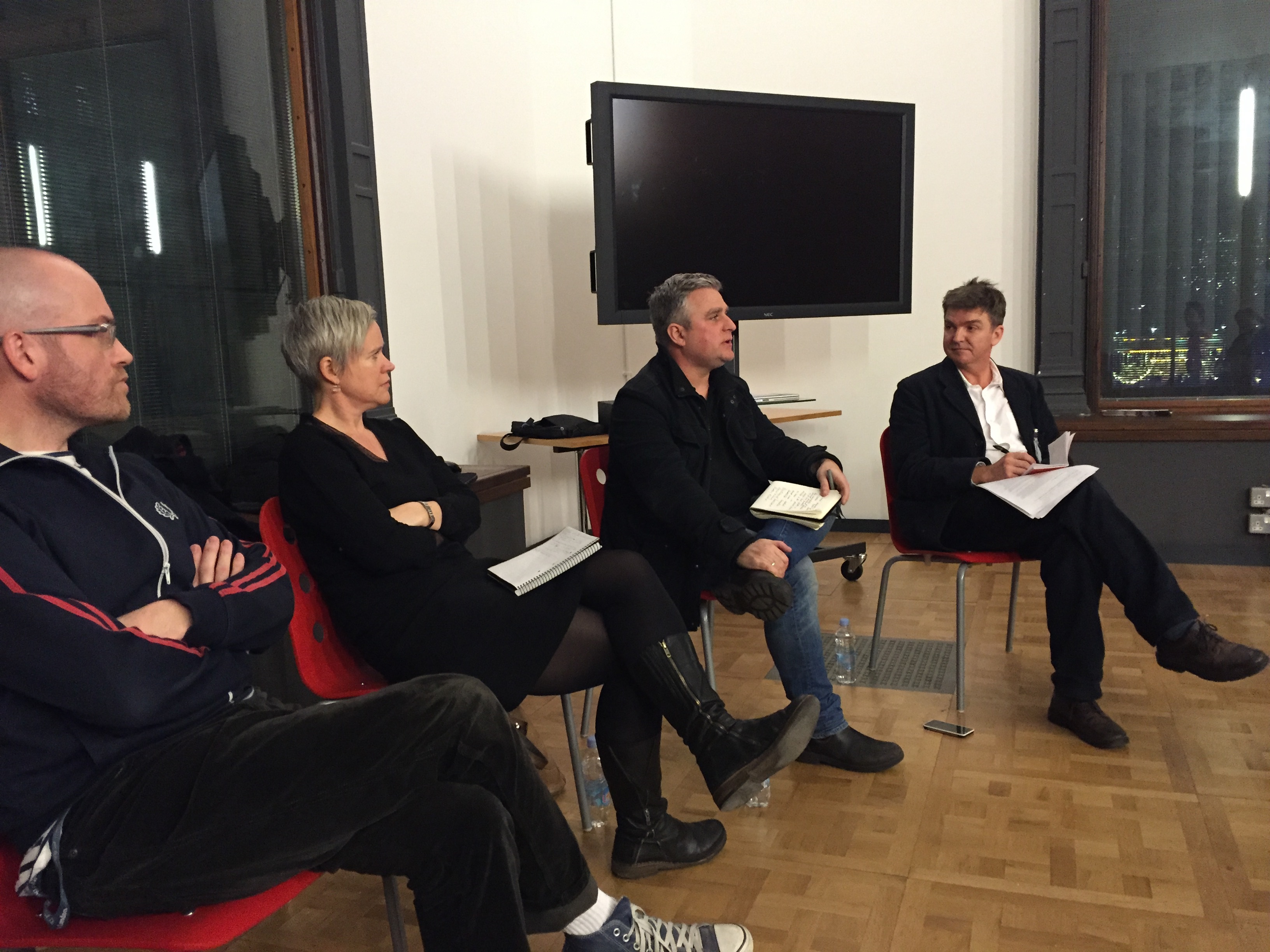
l. to r.:  Jamie Brassett, Lucy Kimbell, Duncan Fairfax, Guy Julier Photo:  Jocelyn Bailey

l. to r.: Jamie Brassett, Lucy Kimbell, Duncan Fairfax, Guy Julier
Photo: Jocelyn Bailey

Opening play, I tore into the possible circularity of the dominant, economic arguments for innovation. ‘We live in turbulent times, and so we have to innovate to stay ahead’ we are told. But where does this tubulence come from? Okay, we could name climate change, the rise in commodity prices or the increasing economic weight of BRIC countries. But we might also add in a vigorous, ideological adherence to a belief in innovation itself as something that is constantly destabilizing markets and social life.

Noting the way that so much policy was being reframed under ‘innovation’ (e.g. the Technology Strategy Board being re-named as InnovateUK), it was asked whether innovation itself has reached the ‘peak of inflated expectations’? (This is taken from the so-called Hype Cycle that describes a common pattern to expectations regarding new technologies.) How far have we actually come from the 2005 Cox Review of Creativity in Business?

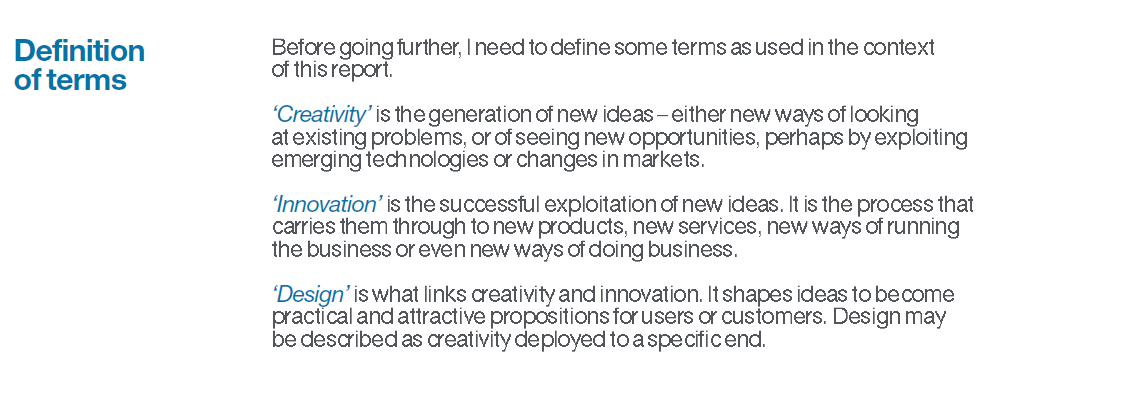
Useful working definitions from the 2005 Cox Review

Useful working definitions from the 2005 Cox Review

Jamie Brassett responded by arguing for a re-framing of innovation. First, he noted that understandings of innovation were largely configured around a ‘for economic growth’ discourse and that there is little critical opposition to this notion. Second, ‘innovation’ is really about the promotion of sciences over other fields where it might be equally important. Third, and leading on from this, he invoked Joseph Schumpeter’s 1911 discussion of innovation expounded in his Theory of Economic Development; here, Schumpeter included social and cultural change within his definition of innovation, something which the drive around economic growth has left behind.

Lucy Kimbell mapped out three current and prominent scenarios for innovation. These were: financial innovation where attempts are made to create new systems and arrangements for flows of capital; innovation in government and public policy making; and innovation in energy production and conservation in the context of climate change. Focusing more on the second of these, Lucy gave an outline of the Cabinet Office Policy Lab that she is working with as an AHRC Research Fellow. She drew attention to how, by including ethnographic approaches or creating ‘personas’, policy-makers are innovating their processes. In this they are thinking about the socio-material arrangements within which policy is bound up. At the same time, it is also recognizing the constantly performing provisionality of policy – that is, it is never finished.

Duncan Fairfax picked up on this idea of the performance of innovation. He argued that innovation is ‘over-rated’, meaning that it is subject to performance analysis techniques and, indeed, is framed by these. In other words, innovations are only innovations when they are recognized as such and it takes systems of measurement to do this recognizing. Practices that are outside understood systems of measurement cannot enter into the frame of innovation, therefore. Innovation becomes a performative practice, done in order to satisfy pre-ordained targets or requirements. Invoking Derrida, Duncan argued that it is impossible to get out of this; invention is always within the known space of actualization.

(Or as Derrida put it in an interview, ‘… the choice is not between repetition and innovation, but between two forms of repetition and two forms of invention. So I think there are inventive forms of respecting the tradition, and there are reactive or non-inventive forms. But I would not say that in order to invent something new, or to make something new happen, you have to betray the tradition or to forget the tradition.’)

This leads us to think outside the box (ha! ha!) and to ask what innovation could be? Design thinking seems to sometimes get reduced to an algorithm, a set of abstracted procedures that conform to known structures and outcomes. What else is there? How, for example, can we get beyond the false construction of ‘user needs’ where users are positioned as ‘needy’ and in some form of poverty?

At this point there was talk with reference to Jean-Francois Lyotard’s 1974 text The Libidinal Economy. I’ve always taken Lyotard to be wrapped up in all that Postmodern stuff around unending, superficial, jouissance-inflected sets of glances and exchanges. Certainly the libidinal economy is about an intensive drive to get out there and do your thing, regardless of the consequences. However, it seemed that, in contradistinction to the narrative around innovation that had been gathering through the evening, the libidinal economy at least offered a place to exercise our desires outside the strictures of audit culture. And if our desires are, in fact, social justice, sustainable living or democratic participation (as opposed to ‘growth’ or consumer culture), then we might be going somewhere else.

This is where we moved to a more optimistic and less-restrained view on innovation. Things were looking up. Within this Lucy Kimbell made reference here to Geoff Mulgan’s take on social innovation in which scaling is a key factor. Thus there is the sense of continual prototyping and developing wherein scaling itself involves new forms and processes. At the same time, I asked, can we talk also about scaling down to produce more precision, intimacy and stewardship?

Drawing on Gilles Deleuze (who else with Jamie Brassett in the room who is about to publish a book on Deleuze and design?) we discussed the proposal that acts of creativity should open up spaces for the creativity of others. There may be other ways of allowing this to happen by, for instance, deliberately not innovating or not designing. Preservation might be a radical act. Equally, managed decline might be a more human and more sensible approach to problems sometimes.

Duncan Fairfax, on a final counter-attack that expanded on a brilliant intervention from an audience participant, added that  ‘provisional performativity’ is where we might be going and where there is a sense of on-going prototyping and experimentation. This dumbfounds accepted notions of innovation as an end. The outcomes of innovation might not necessarily be preordained or formed around received systems of measurement and evaluation. Thus, he slotted the final goal into the back of the net with two moves:  let’s imagine innovations that can be efficiently destroyed and/or produce ones that can be turned into something else. This represents a fundamental challenge to our current modes of cognition and intention.


Guy Julier


Posted in innovation, publics, social innovation | 1 Comment