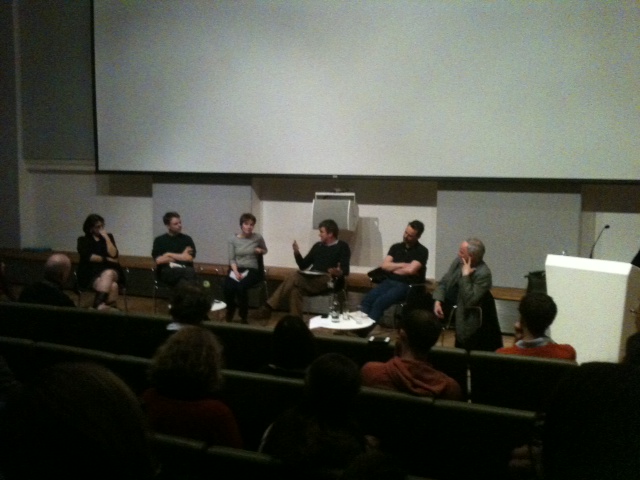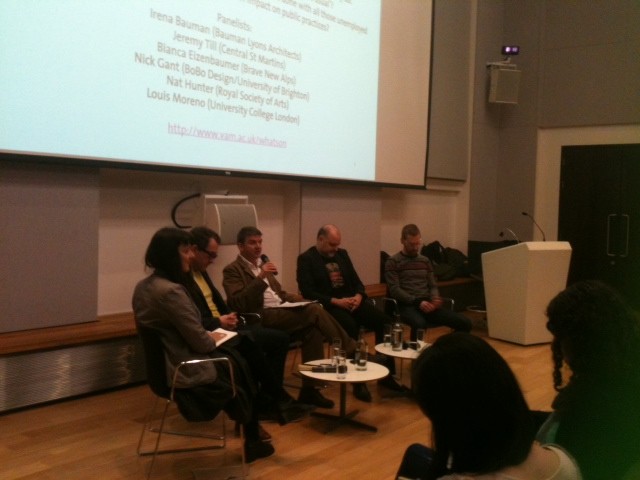
Salon 7 — Reflections on Transparent Design

How we think about the information that is embedded into design or that accompanies it in its processes and products is inextricably linked to the larger contexts of political economy. The misinformation or, at least, misapprehensions that have surrounded the workings of financial institutions running up to the economic crisis has created one vector of influence on the debate. Activist attempts to open up restricted governmental information has opened up another.

How designs are constructed and interacted with, how their meaning is formed is brought out when we use computers. Working with digital information encompasses skimming and coding. You surf its information or you can dive deep into its informational architecture. Each of these notions, and these working together, have wider implications for how design culture is constituted and can constitute itself.

An overarching question of the differences between transparency and openness emerged that quickly brought in political and ethical questions. This salon moved through this and many other questions.
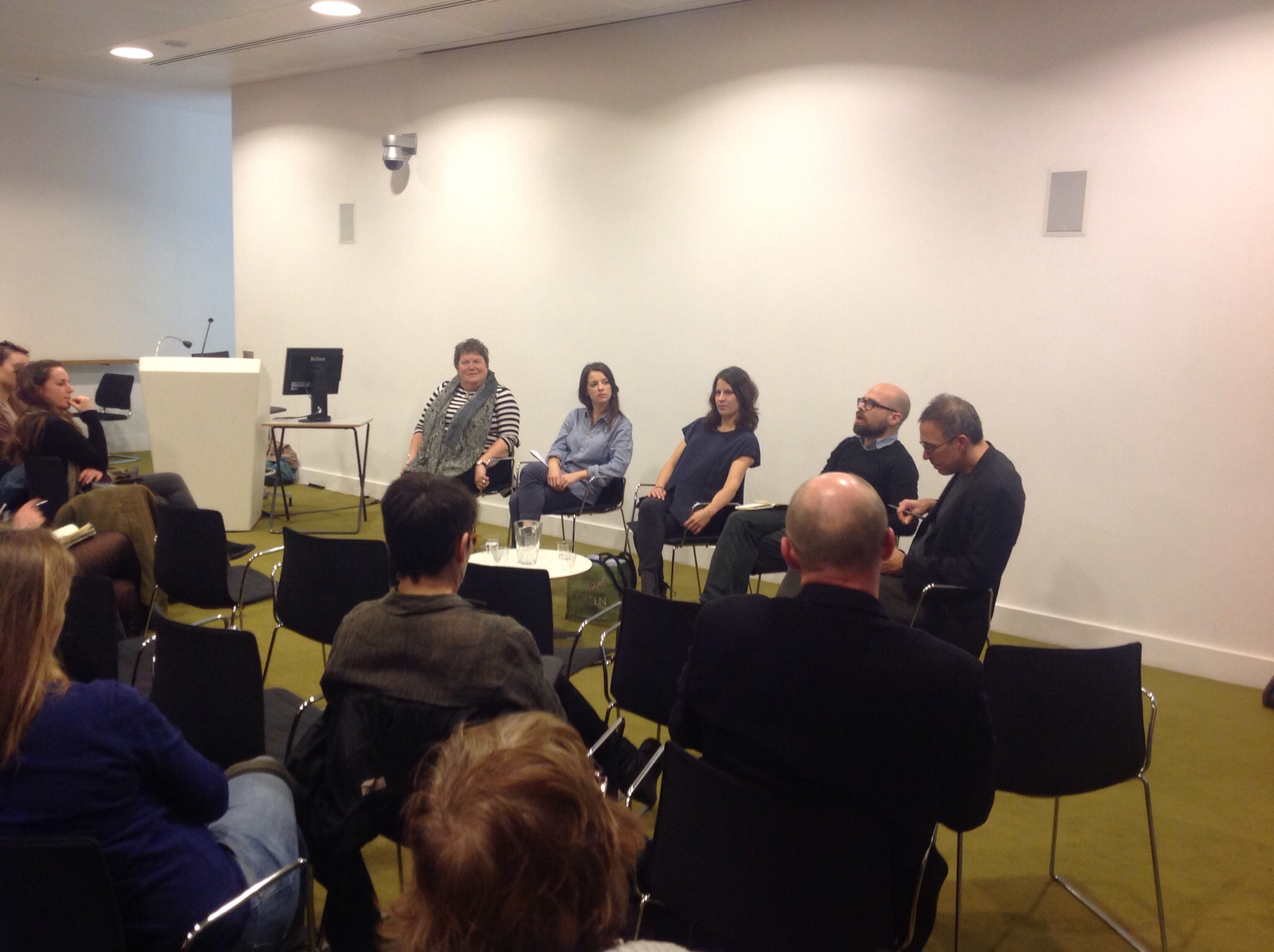
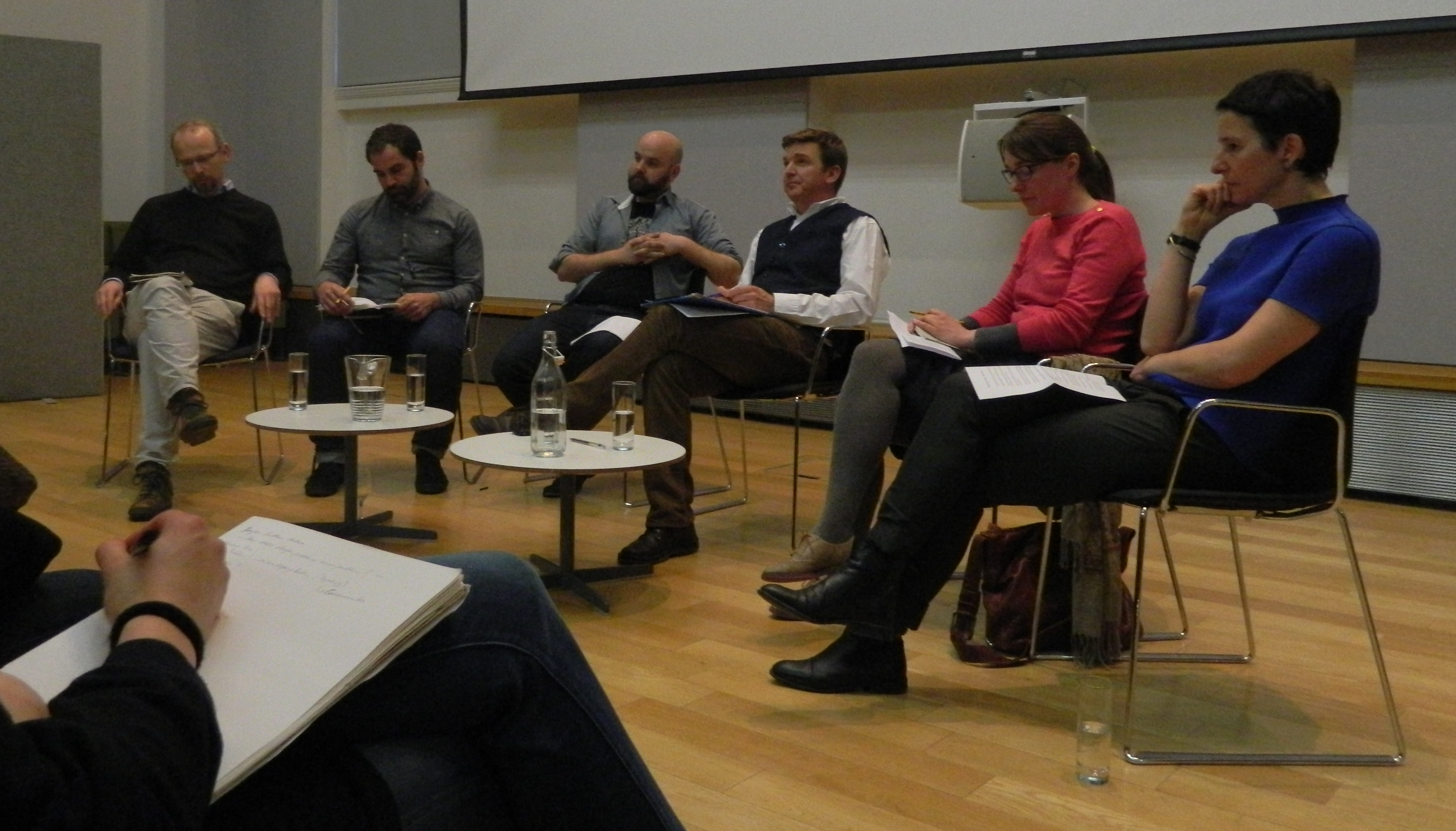
Left to right:  Gillian Youngs, Jessi Baker, Alison Powell, Martin Dittus, Kevin Walker

Left to right: Gillian Youngs, Jessi Baker, Alison Powell, Martin Dittus, Kevin Walker

Martin Dittus described his organisation, London Hackspace, in terms of the benefits that it accrues through being open. This means open in the sharing of knowledge within it but also in its own governance. Openness can consistently run through an organisation so that, for example, playful and more applied practices can co-exist.

With the visual and material aid of an electric toaster, Alison Powell described two approaches to the object, deriving her observations from the work of Martin Heidegger. One was to view the object as ‘closed’, as a means to an end. The other is open and observable, where the processes to make toast are laid bare. But there is a separation. Even if the means of production can be seen, it doesn’t necessarily follow that we can engage directly with them. In the former, it is, in Heideggerian terms, ‘ready-to-hand’; it can be used. In the latter, with the toaster taken apart and broken, we have a different engagement with our technologies. It is a way into their politics. And this is where all of the politics of hacking is located. How do you bring the these two levels of the object together? This is an interesting design problem.

Jessi Baker spoke of her company, Provenance, that helps companies and organisations understand and communicate where the materials they use come from. Jessi made a distinction between transparency and openness. The former is really an ability to convey facts. This can be manifested actually in products:  so, for example, antiques carry the story of their life-use through chips and scratches. Self-referentiality can also achieve this, as in, former V&A Artist in Residence, Julia Lohmann’s Antonia Cowbench which is made of leather and is in the form of a cow. The origins of its material are clearly expressed in the form. In terms of quantities Jessi Baker has been thinking about ‘quantified stuff’ – things that, for instance, declare their own embodied energy. By extension, for her, design is about fate – how you shape the outcome and experience of things.

Political economist Gillian Youngs began by declaring that she had been studying the internet since its inception. As a scholar of globalization beforehand, she has been interested in the macro-forces that information technology are bound up in. She emphasized that the so-called digital revolution is quite distinct from other technological revolutions. Our relationship to it is embodied and intellectual and it engages with every aspect of our lives. Pivotal in this is that it connects us as individuals to a whole and this is how she came to it from a globalization perspective. Following on from this, her own generation has been raised thinking that politics, economics, culture and the social are segmented, whereas ‘digital natives’ experience these as enmeshed with one another. Even so, digital culture has grown out of the former world and institutionalised policy arenas continue to dominate with this paradigm of segmentation. Hence, Gillian opines, governmental notions of ‘innovation’ still haven’t got beyond the industrial revolution in their conception of it. For them, the digital revolution is just another stage on from the industrial revolution rather than a radically restructuring process. In the meantime, too little attention has been paid to NGOs as innovators in information society. This brings the argument back to small-scale groups, like Martin Dittus’s London Hackspace. But the institutional predominance of other models means that the idea of innovation is still being distorted.

Our chair, Kevin Walker, asked why transparency should matter? Martin Dittus replied that this needn’t have to be there all the time, but from a political standpoint there should be a right to it if required or requested. Alison Powell reversed the argument to posit that there is no democratic accountability to the transparency to which we are being subjected. In short, data on us that is held by government and corporations or how it is used is not accessible or, at best, very difficult to uncover. We leave data trails that we can not track back on. Meanwhile, by leaving a trace we are verifying that we are busy doing all those things that contemporary capitalism expects of us. You have more to fear if you are not displaying all the time, she argued. Jessi Baker suggested that when signing up on the internet to a service such as Facebook, you should go through some kind of check-out process to demonstrate to both parties that there was some kind of value exchange going on. Gillian Youngs came back to the problem of the distinction between material and informational exchange, or the lack of distinction that institutional forces make between these. Thus, big data is treated too much as just another material resource or object, rather than deep regard being paid to its differences, subtleties and complexities as ‘information’. She went to talk about ‘automaticity’ where we engage with information (for example through our smartphones) unconsciously, unaware of the politics of the systems that we are engaging with. How often do we read ‘Terms and Conditions’?

Design is where some of these trade-offs can be made evident and, indeed, the politics of design itself. Martin Dittus reminded us that notions of transparency are culturally specific and that there are different locations and standards applied in different locations.

The next question is, who is pushing transparency? Kevin Walker asked how is hacking then corporatized in a way that creates conflicts between individuals and institutions? Martin Dittus pointed out that hacking is predominantly the preserve mid-20s, white, middle-class males and this needs to be addressed, perhaps as a way of breaking this constant defection from individual creative practice to corporate interests. Perhaps another demographic will open onto other pathways. Gillian Youngs agreed that greater inclusion of women in the discursive field of innovation may lead to new forms and processes in business and elsewhere.

Much of the rest of the salon went on to discuss information asymmetry. Where and for whom is it most beneficial to provide data? An example that was cited was the Fairphone which, at the time of this salon, was going through self-declared difficulties in its supply-chain. This start-up is dedicated to complete transparency in its operations, a risky activity in the world of smartphones which tends toward the other extreme (witness Apple’s secrecy in its operations). In which so ever case, the internet allows smokescreens to be eroded, argued Jessi Baker, as information is revealed through hacking or hacking-like activities in any case. Meanwhile, Alison Powell adds that political agency and disruption should not just come through hacking but through a range of practices.

It seems that transparency is a challenging and compelling concept for design. It places up front a series of questions as to how we design, its timeframes, publics, priorities and outcomes. If the institutional apparatus of governance is so far behind what the information revolution affords and implies, then it might be some while before mainstream notions of innovation catch up and the possibilities for transparency become truly appreciated. Meanwhile, the salon made clear that it immediately engages deep questions around the politics of design.

Finally, a salon attendee has kindly emailed with a suggestion for further reading. Rosie Wanek recommends Marek Bienczyk’s book Transparency (2012) that, she says, offers useful further historical context to the discussion. I give this information out in the interests of openness and participation that we hope the salons reflect.
Posted in Uncategorized | 1 Comment

Salon 7 — Transparent Design: what does it mean?

Friday 10th January, 1900h
Seminar Room 1:  Sackler Centre, the Victoria & Albert Museum

From banking to national security, the notion of transparency has been a popular subject of late and was high on the agenda at the G8 summit last year. Transparency, openness and provenance are also emerging as strong principles in contemporary design practice, across a range of disciplines. But what does transparency mean in a design context? Does it mean different things to different people? How has it changed the relationship between the designer and consumer? How has open data changed things? What are the ethics and politics of transparency and is this is being adequately factored into design practice?

Chair: Kevin Walker, Head of Information Design, RCA

Jessi Baker, Founder of Provenance and PhD Candidate, UCL
Alison Powell,  Assistant Professor in Media and Communication, LSE
Martin Dittus, Trustee and Founding Member of London Hackspace
Gillian Youngs, Professor of Digital Economy, University of Brighton

This event is free but booking is essential.
If the booking page shows as ‘fully booked’ please email g.julier[@]vam.ac.uk to reserve a place.

Posted in Uncategorized | Leave a comment

Reflections on Design Culture Salon 6: Food and the City: How do new food systems impact on our towns and cities?

Image

L-R: Matt Skinner, Alma Clavin, Gabriel Wulff, Doina Petrescu and Andre Viljoen.

Introducing the sixth Design Culture Salon, our chair for the evening Gabriel Wulff stated that from ‘guerilla gardening’ to ‘urban bee-keeping’, the topic of designing food systems has been building an audience in the UK. This was clearly visible in the high numbers who had turned out to talk about ‘food and the city’. The fact that it was a) raining and b) Friday night at the peak of the party season, made this full, lively attendance all the more encouraging.

For someone coming from outside the topic, as this writer is, the field of food design and urban agriculture is a fascinating one because it cuts across so many other disciplines, including design activism, a previous salon topic, and more broadly, politics, economics, geography and health. For those working in the field, the salon discussion was an opportunity to reflect critically on its aims, goals and some of the challenges ahead. To begin, Gabriel Wulff contextualised the field of urban agriculture, which emerged from the economic and industrial conditions of the ‘creative industries’ at the end of the 20th Century. The question he put to the panel was, where do we go from here?

Andre Vlljoen, from the University of Brighton, was the first to share his thoughts. Reflecting on his collaborative work with architect Katrin Bohn he stressed the importance of visibility in approaching strategies of urban food production. He said that they had started their work by thinking about what cities would look like if you started to introduce food to them. Both bottom up and top-down approaches are required and, crucially, the two need to work together. One without the other wont work for a ‘productive urban landscape’. He spoke about space as one part of a bigger equation:  other parts of which are inventories of urban capacity, managerial skills and understanding of how spaces run in the long term. Andre also emphasised the importance of being responsive. There was an assumption for instance, in the early years of his work, that most of the work on urban agriculture would take off on the ground, but there has been a lot of activity on the rooftops recently. The challenge, he suggested, was in convincing people that these spaces are part of an essential infrastructure. Otherwise, they will never gain traction and always exist on the peripheries.

Doina Petrescu is a leading figure in academic discourse in urban agriculture, but this evening she spoke directly from her experiences through the Atelier d’Architecture Autogeree (AAA), self-initiated community gardens projects in disused urban spaces in Paris. The starting point, she stated, is about claiming the space. Many of these projects worked within mobile and temporary tenses, where they worked as a trigger for addressing other questions- ‘to initiate collective strategies and move forward collaborations to re-invent the commons’. In this sense, she brokered one of the major themes of the evening, which is to say that food is a currency through which to address something else. If urban agriculture is a form of co-production, Petrescu argued that this production is not about quantities of food, but social capital and wellbeing. From this perspective, food growing can be seen holistically as part of a wider resilience strategy. For these reasons, work in this field constitutes a new form of professional practice, combining elements of social work and public relations.

Alma Clavin has been researching urban food growing for eight years. She currently works for CPRE, where she helps run the campaign for a more ‘Liveable London’, and her response reflected on this work as well as her broader research. There can be a perception in cities, she stated, that there is nothing going on locally, no space for creativity and that people sometimes see food growing initiatives as middle class initiatives that are not inclusive. Like the previous speakers, Clavin described urban food growing as an opportunity to address bigger issues relating to politics. Fundamentally, she argued that practice in this area builds on lived experience around the individual and works with tacit knowledge. She highlighted a number of challenges in the field. For instance, there are now almost 2000 community gardens in the UK and over 300 food growing spaces in Northern Ireland- this is significant growth since she started work in 2005 — but she warned, activity can peter out. How do we maximise transformational capacity of food growing? Clavin felt the answer might lie in overcoming binaries (local/global; fast/slow food; urban/rural) and thinking more about relationalities in designing, developing and planning our food growing systems. This might also involve thinking beyond stereotypes of the planner and the developer.

Matt Skinner, project leader at FutureGov’s Casserole Club, had just returned from Melbourne where he had been discussing the possibility of running a pilot scheme there. His response made a valuable contribution by opening the subject up to a wider view of how designing food initiatives can impact our cities. The aims of the Casserole Club, a voluntary food-sharing initiative, are to tackle some of the issues raised by the panelists: reducing isolation, facilitating inter-generational relationships and reducing food waste. He described how one of the major challenges of the project, interestingly, was in finding diners, not cooks (they now have 3000 cooks registered in the UK). While ‘foodie culture’ in Britain has created ripe conditions for people to share recipes and cooking stories online, diners, most of whom are aged over 70 and are socially isolated, are not  well-connected to this. Technological, as well as cultural barriers need to be negotiated. It has been key, therefore, to work with local councils in addressing these issues of isolation. Skinner positioned the project alongside others, including the Incredible Edible project. ‘What we are learning from this and other projects’, he stated, ‘is that food, in particular home-cooked and home-grown food, is a powerful tool for bringing people together’. Again, the visibility of these projects was stressed as a factor in their success, whether through online platforms or in physical spaces in the city.

By this point, it was clear that all four panellists were talking about food as a currency for participation and Gabriel Wulff asked the panel to elaborate further on the dynamics of this participation. What need does it respond to? Petrescu suggested that the movement was a symptom of the need to do things collectively, a method of claiming space and finding a social norm, especially in the environments she had worked in, where unemployment levels were high. Interestingly, Andre Viljoen argued that participation is important but it is not the only way. The reasons for thinking and making productive urban landscapes is not always about the social, but is also about the environmental and can also be political.

There were quite a few architects and design practitioners in the room, and many asked about the implementation of these projects.  As one put it, ‘food is a good idea- but how do I use it?’ The panel described the process of working with local authorities and identifying the right people as key elements in the process. But, as Doina Petrescu reminded us, these things take time for good reasons. In many instances it is about building a culture and this, clearly, is not a quick or easy process.

Other practical questions addressed the issue of commerciality. While many of the practitioners pointed out the notable absence of this word from the discussion, the panelists assured us that this was not the case. Matt Skinner said that one of the earliest discoveries in Casserole Club was that diners did not feel comfortable taking food for free, but equally that cooks would not accept payment. They are beginning to look at the possibility of a ‘rewards scheme’ as a non-monetary method of placing value on the exchange. Doina Petrescu stated that making money was an important output, as long as you are transparent about the kind of system you are running.

Another question eloquently addressed the subject of knowledge and memory in relation to food. Knowledge migrates with people moving in and out of cities and also can be lost in generational gaps. How can these gaps be breached? How can young people acquire knowledge about growing food at a practical level? Gabriel Wulff stated that it was important not to be too nostalgic about what has been lost, but rather to appreciate and embrace what is new about working in the field today and build trust in new learning spaces.

Many questions focused on the binary of rural/urban which had been partially addressed and there seemed to be some anxiety about the relationship between the two. However, as Andre stated, designing urban agriculture systems has never been about producing enough food to feed the entire city. This is simply not realistic: most people can do some of it but obviously not everyone wants to.

Social well-being was another issue that concerned the audience. While Alma Clavin stressed the relationality of this at an individual level, Doina Petrescu argued that she had used time measurements in assessing social well-being impacts, by watching the evolution of people taking on responsibilities and agency within the project. Many participants had initially started by ‘just watching’. Providing the space for this social observation is therefore important.

By this point, the salon was running into extra time and there were many more questions being thrown around the room. In answering a final question that neatly addressed many of the evening’s key themes, Gabriel Wulff explained the concept of resilience in relation to food design. Food, he said, stands for something else– it connects us directly to public issues like health and politics. It is visible and relational.  It is less about high ideals, he stated, and more about working through issues on the ground.

This concluded Design Culture Salon 6 on Food and the City. The next salon is on 10 January 2014 at 7pm in the V&A Museum on the Transparency in Design. Booking is free, but essential. Book here.

Leah Armstrong, University of Brighton/V&A Research Officer in Contemporary Design Culture

Posted in Uncategorized | Tagged , , | 1 Comment

Design Culture Salon 6: How do new food systems impact on our towns and cities?

Friday 13 December, 1900h-2030h

Seminar Room One, Sackler Centre, V&A 

How do new food systems impact on our towns and cities? 

Chair:  Gabriel Wulff (University of Brighton)

Panellists:

Alma Clavin, (Liveable Cities, CPRE)
Doina Petrescu, (University of Sheffield)
Matt Skinner, (FutureGov)
Andre Viljoen, (University of Brighton)

Food has re-emerged as a central concept in debates regarding how we design our cities.Current practices linked to the growth, production and distribution of food are being questioned as contemporary cities become larger and more populated.In these landscapes, the desire to re-design our relationship to food is reflected in the emergence of alternative food focused urban initiatives – from community supported agriculture systems (CSAs) to rooftop gardens and urban farming projects. Re-thinking food has also been combined with the delivery of public services, improving the urban environment and enhancing community cohesion. These projects are varied in their methods,visions and goals and have socio-cultural, economic and environmental repercussions, as well as the potential to catalyse a politically active citizenship. What can we learn from these food based initiatives? What are their aims and approaches and how far do they achieve their goals?

Alma Clavin has worked in Ireland and the UK on planning, energy and sustainability issues. She is currently Project Officer and expert panellist at Liveable Cities, CPRE, London. This project is an ambitious five year programme of research to develop a method of designing and engineering low carbon, resource secure, well maximised UK cities.

Doina Petrescu is Professor of Architecture and Design Activism, University of Sheffield. She has written, lectured and practiced individually and collectively on issues of gender, technology, (geo)politics and poetics of space. She is the editor of Altering Practices : Feminist Politics and Poetics of Space (2007), co-editor of Architecture and Participation (2005) and Trans – Local – Production: Cultural practices within and across, (2010).

Matt Skinner works for FutureGov, where he is Project Leader for Casserole. This initiative works to reduce social isolation and improve meals on wheels services by coupling the willingness of regular people to cook an extra portion of dinner to share with the needs of local community members who struggle to cook for themselves.

Andre Viljoen, joined the University of Brighton in 2001, acting as subject leader for undergraduate architecture.  Andre is a leading figure in the field of urban food production, its rationale, urban and architectural design implications. His work is cross disciplinary, engaging with artists, design and development practitioners/researchers and the public.  Currently he oversees the undergraduate and postgraduate architecture programmes.

The salon will be chaired by Gabriel Wulff, PhD researcher at the University of Brighton. His interests include socio-ecological spaces, community gardening and neighbourhood activism.

Free. Booking here is essential. If the V&A website says that the event is fully booked, please email l.armstrong[at]vam.ac.uk to book.

See ‘Future Salons’ section of this site for full programme of Design Culture Salons.

Posted in Uncategorized | Tagged , , | 1 Comment

Design Culture Salons: A Summary

For a profession that deals with objects, images and spaces, there’s a lot of talk in design. Client presentations, team briefings, studio crits, professional practice talks, office chat and so on. These form part of what we understand as ‘design culture’ – the interweaving of things, people, knowledge, resources and the various ways by which these are talked about. Through their constant flux and interaction so design culture shifts its shape, dynamics and points of concern.

The V&A Design Culture Salons provide a forum for discussion as to the role of design in contemporary society, extending everyday ruminations on design into advanced, expert debate and back again. They are organised and chaired by Guy Julier with the support of the University of Brighton, and the Research and Learning Departments of the V&A.

Each salon addresses a specific contemporary question. The 2012-13 season’s points of discussion were as follows. What can museums do with contemporary design? Is ‘making’ back on the agenda?  Design Activism: how does it change things? How does design function in a recession?  How does design produce new publics?

A brief introduction to the topic of the evening by the chair set the polemic for an invited panel of four or five speakers to give their personal responses. Audience participants as part of the wider salon, then entered into the debate, with thoughts, opinions and provocations. Averaging over eighty in numbers, attendance came from academic institutions, as well as those working in public policy and from the architecture and design industries. The liveliness of the discussion was evidence of a highly engaged and well-informed audience.

Although the salons functioned as a forum for public debate in an open and inclusive way, the series also offered an insight into the current texture and tempo of the debate among design researchers and academics from conjoined or related fields. Over the past few years the fields of social design, open design, co-creation, sustainable design, design activism and critical design have been developing in parallel and in relation to one another. The salons provided an overview of how some of these disciplines have become sharper and more defined as well as some of methods by which they are addressing necessary questions of implementation.

As anyone who follows these subjects in their theory and practice will know, approaches and methods are often varied, sometimes contradictory and too disparate to be united under a coherent ‘agenda’. It was therefore interesting, upon reflection, to note the emergence of some dominant themes from the Design Culture Salons. These are summarised in four headings and point to some of the ways in design culture is developing and progressing as a discipline and in practice.

Producer Equals Consumer

A flurry of recent media reports have announced the ‘democratisation of design’ brought about singularly through 3D printing. However, the salons addressed this issue as part of a bigger picture, looking at how the principles of co-design and co-production have been changing the way designers work in a variety of contexts. Sustainable design professor, Ezio Manzini recently stated that the aim to reduce consumption has been matched by an aim to increase ‘something else’. This ‘something else’ has a social quality, which the salon panellists suggested might come from designers facilitating, articulating and sharing concerns through social conversations.  A majority of the panellists were engaging with this approach at some level, with the strongest advocates, Joe Harrington and Paul Micklethwaite presenting compelling evidence of how they have used it in practice. Daniel Charny described the role of the ‘prosumer’, whereby producers and consumers are sharing tools, ideas and techniques. On the other hand, questions of authorship have recently been challenged and Jana Scholze drew attention to the darker inflection of this debate. Citing the example of drones technology, she argued that in many contemporary cases designers are intentionally masking their identity in ways that work outside traditional notions of responsibility and ownership. In these cases, not knowing who has commissioned the work, or understanding in clear terms who it has been created for, poses vital questions about ethics in contemporary design practice.

Drop the ego

Does design activism really change political or social structures, or does it merely reform things within existing parameters? Any reformative zeal was strongly challenged as several panellists urged designers to drop the ego. Irena Bauman and Joe Harrington both spoke of the ego-centric designer-hero as an obstacle to the transformative capacities of design. Entitlement and hierarchies need to be dissolved, egos dismantled. Any mysticism around the concept of making was also challenged. Glenn Adamson provocatively critiqued the ‘assumed permissiveness around making’, arguing that ‘craft could be a tool of social repression’ as much as emancipation. This salon doused some realism on the idea of the designer-maker, with Katie Hill arguing that ‘making comes of necessity’. Designers were urged to get real. Jeremy Till quipped that designers might begin to think about how to work in a recession by ‘getting used to it’. A similar point was made about the role of the contemporary design curator in the first salon. Jane Pavitt stated that ‘public access to an exhibition is not just getting a ticket and wandering around it’, suggesting that curators need to attend to wider public concerns. This idea of being open and outward facing, rather than focused on internal professional issues, was a unifying theme. However, as Louis Moreno stated, it is important that this engagement with the outside works to critique as well as serve the publics it faces.

Tell Stories

Paying close attention to the language of the debates, and in particular, the ways in which designers describe their practices, can give a uniquely revealing insight into how designers work, or perhaps more accurately, want to be seen as working. The language of ‘storytelling’ was used in almost every salon. Nick Gant, discussed his mission as a material activist through making as a ‘way of constructing narratives’. Jonathan Chapman described design activism as ‘in between stories’, elegantly stating that ‘it moves the pages of a story and therefore has the power to nudge the narrative in one direction or another’. On the other hand, Adam Thorpe cautioned that the designer’s capacity to invent and imagine can lead them to ‘run ahead and create fictive publics’. This idea of the designer telling tales and connecting narratives was also alluded to by Jeremy Till, who said that designers are good at being relational- in other words, making the connections between economic, cultural, social and material. It is ironic then, that one of the commonest critiques of the design professions is their inability to get their story heard and understood by outside audiences, as the Design Commission recently argued. As Jocelyn Bailey stated, the government, even when interested, struggles to fit what they view as aesthetic judgements, into policy narratives. Therefore, if designers want to see themselves as good storytellers, they need to find ways to tell these stories in clearer and more engaging ways to those outside- government, client and public.

Slow things down

As Guy Julier pointed out during a couple of the events, the pace at which designers, policy makers and governments seek to act varies dramatically. Policy documents and surveys by design organisations convey an industry in a sense of panic. Much of the rhetoric being spun at government level is concerned with short-term, quick-fixes linked to a political agenda (such was the case with the New Labour Creative Industries policy agenda). But the salon panellists in general looked for a longer-term approach, working slowly and across publics, with collaborators. Noortje Marres encouraged designers to work in ways that were implicated in real issues, outside design, in real time, a suggestion that might reflect the tempo of all sensible debate post-economic crash. Bianca Eizenbaumer and Fabio Franz of Brave New Alps spoke of their mission to pursue this approach, which involves creating and working on long-term social relationships, in the face of the everyday pressures of running a design studio. The salons therefore successfully brought into focus the conflict that runs through many contemporary design practices, as they attempt to work both inside and outside existing systems and networks. As Guy reflected on salon 2, the contemporary designer needs to have ‘an outward looking, connected mindset but also a focus on problems and solutions that are close to hand’. Some of these practical issues are discussed through case study presentations at the Social Design Talks, run by the V&A and Policy Connect .

By the end of the 2012-13 salon series, the five opening questions had therefore inspired a series of fresh questions, pointing out in new directions. Perhaps more significantly, old hang-ups and historic debates within the design profession no longer appear to be of interest. For instance, the question is no longer whether a designer can be an agitator, communicator, activist, maker, strategist. The possibility to be all of these now seems assured. Some of the ways in which design might act as a catalyst for social innovation were confirmed– it is the question of how that is up for debate. The next step will be to reflect on more practical concerns about putting this into practice. And that makes contemporary design culture such an interesting place to be.


Posted in Uncategorized | Leave a comment

Reflections on Design Culture Salon 5: How does design produce new publics?

The idea of what, or who, constitutes a public takes fundamentally different forms under different authors. Proclamations of the public in singular, ‘One Nation’ and ‘Big Society’, form rallying calls for the current political parties. As Guy Julier, who chaired the evening pointed out, Margaret Thatcher famously stated, ‘there is no such thing as society, only individual men and women and their families’, while Tony Blair obsessively leant on ‘the people’ , as an ideological tool in his everyday vocabulary.

The early design reform movement in Britain was motivated by the aim to educate the public on matters of taste, whether  through the Council of Industrial Design (1945), (now Design Council), the V&A or even the Design Museum (1989). But the design landscape has widened beyond recognition since then, with an understanding of design that is both material and immaterial.

So where does the public fit into this bigger picture? Breaking the question down into its constituent elements, Julier posed the questions: Does design make a specific claim to new publics? Produce or reinforce? How new? Are there better terms than publics that we can use?

SalonGJ2

Adam Drazin was the first to offer his view in a position statement that opened up many of the central themes for the evening’s discussion. As an anthropologist, he affirmed the validity of the question by stating that design works differently in different places. Centrally however, he argued that architects and designers sometimes set up expectations and environments to create publics, but that this is sometimes artificial, resembling a one-way dialogue. The hierarchy of ownership implicit in any design project calls into questions issues of legitimacy and entitlement, stating that designers must always question ‘why should people come to your tent in the public space?’ Speaking from experience of his time in Romania, where public squares and spaces were void, he stated that the concept of publics should not be taken for granted. Publics do not necessarily exist, he argued, rather they are a process and this longer-term view is essential to design.

Adam Thorpe threw out the question of who cares? Referencing John Dewey’s publication The Public and Its Problems, (1927), he stated that publics ‘snap into being around issues of concern’. The designer’s role is to act on this by articulating and sharing concerns, through ‘social conversations’.  Design can produce physical objects that respond to environmental concerns , such as through his fashion company Vexed generation that produced face-mask design parkas in response to the increased pollution and the use of cctv cameras in Britain in the early 1990s. This, Thorpe suggested, is how designers can start conversations.  This materiality does not have to be physical however. Other examples in his experience include exhibitions and film screenings by the Design Against Crime group at Central Saint Martins which drew attention to the public issue of cycle theft in an engaging and communicative way.

Joe Harrington added another dimension as an advocate for the co-design method. More specifically, his experience in the Lambeth Collaborative aims to apply the principle of co-production to radically change mental health services. The collaborative is made up of leaders, carers, GPs and psychiatrists. They define co-production through the following key principles:  blurred distinction between public and professional; reciprocity; mutuality; building on people’s assets and networks they already have and facilitating change.  Harrington was overtly critical of the heroic designer-centric culture that has traditionally been embedded in design practice. One of the main challenges, he argued, was for designers to write themselves out of the process and focus on the concept of design as a transformation. He argued that ideas require lots of people and needs to be seen as a constant process and core tenet in addressing social change, not a one-off event.

Noortje Marres brought to life a powerful example of how design’s ‘publics’ might be viewed from the outside, through twitter. By doing a quick search on design words that had been hash tagged, such as design thinking, service design and finding their associative terms, she found that 9,2550 distinct users have used design related words in the last week. The main words associated were innovation, start-up, co-design, and problem solving. But is it correct to think of this as evidence of a design ‘public’? Probably not, Marres argued, primarily because these references were not connected to any broader issues such as the environment or health. In many ways this example got to the heart of the question in suggesting that publics can not be made.  ‘An actual public is something that happens and definitely not something that can be created on demand’, she stated. For it to be a ‘real public’, the discussion has to include something other than design as well.

Jana Scholze returned to the phraseology of the question, which she suggested seemed to frame designer and the public as opposing entities. Both these terms and their relationship to one another, she stated, have become increasingly blurred. As an example of this, she cited the London based designers Superflux who recently designed a project to create autonomous drones which form their own temporary wifi to fly around the city. In this example, the identities of public and designer, user and creator, are intentionally masked and blurred, making it impossible to ask practical questions about who is paying for the work, or who the work has been created for. This absolution of responsibility and ownership reminds us of what is at stake in the question of how design creates publics. Equally, this makes the question more urgent.

Guy Julier interjected at this point to highlight some recurring themes that included ownership and temporality. He asked the speakers to share their thoughts on whether they felt that this was an historical moment. Could the same conversation have been had ten years ago?

While Adam Thorpe stated that designers had been called into action around the time of the economic crisis,  Noortje Marres felt that the ‘historical moment’ had been longer and more drawn out than this, with a broader participatory movement in politics. Jana Scholze stated that 3D printing and other recent innovations had made the relationship between the designer and the public more complicated. Therefore the fundamental question might not be new, but its current inflection was. Adam Drazin picked up on some of Marres’ earlier points, stating that ‘imagined communities’ often obscure the view. This is the case in Ireland, he argued, where there is an ‘over-determined sense of community’ but a poor public transportation system. This paradox suggests that ‘fictive publics’ can be culturally or notionally created.

A member of the audience asked the panel to consider the role of counter-publics, seeking a more nuanced response to the opening question. Joe Harrington argued that one of the key roles of the co-designer was to enable dissidents, affording them activism. Adam Thorpe pointed out that there had been a lot of fictitious co-design in the past that had only superficially engaged with publics. On the other hand, he presented the commonsensical view that designers might be misguided in the assumption that they need to seek out new publics, and should remember that they are only making a contribution alongside other members of the public. This was the first time in the debate that a member of the panel had overtly described the designer as a member of the public, though it was re-stated by Thorpe when a member of the audience asked if‘designers are ‘flâneurs or a man of the crowd’.

Towards the end of the discussion, Marres said that she had been surprised that the designer and not the designed object, had dominated the evening’s discussion. This was an interesting point, given that some of the speakers stated that designers needed to ‘design themselves out’. The strongest theme to emerge from the discussion was that of ownership: if design does have the ability to call publics into action, do designers then own these publics? The panel agreed that they should not, but the question of how this would work in practical terms, given the entrenched economic hierarchies of the design practice, was not clear. One promising idea came from the early evocation of publics as a process, meaning that designers should let go, move slowly and, as Thorpe stated, fight the urge to ‘run ahead and create fake publics’.

This post has been guest written by Leah Armstrong, PhD Candidate at the University of Brighton and Research Officer in Contemporary Design Culture at the V&A Museum.

This ended the final design culture salon of this academic year. The Design Culture Salon will continue next year. Please get in touch if you have any feedback on these events, or if you would like to get involved, by emailing L.armstrong@vam.ac.uk

Posted in publics | 4 Comments

Design Culture Salon 5 — How Does Design Produce New Publics?

Tuesday 30 April, 1900h-2030h
Hochhauser Auditorium, Sackler Centre, V&A
How does design produce new publics?

Panellists:
Adam Drazin (University College London)
Lorraine Gamman and Adam Thorpe (Central St Martins)
Joe Harrington (Innovation Unit)
Noortje Marres (Goldsmiths, University of London)
Jana Scholze (V&A)

If, according to Bourdieu, designers are ‘cultural intermediaries’ who undertake ‘needs production’, how are these linked? How might designers create new social practices? Is this merely a commercial strategy (as in ‘brand communities’)? What role does open design or co-creation have in this process? How does the material function in such a process?

Free, but booking is essential: http://www.vam.ac.uk/whatson/event/1971/date/20130430/

Panelists

Adam Drazin is an anthropologist who works on design and with designers. He obtained his PhD in anthropology at UCL in 2001, on the material culture of care in Romania. For the last three years, he has been lecturing in Ireland at Trinity College Dublin on themes including material culture, globalisation and migration, gender and the home. Adam is runs the MA programme in Culture, Materials and Design at University College London. See http://ethnodesign.org.

Lorraine Gamman and Adam Thorpe direct Design Against Crime at Central St Martin’s, University of the Arts, London. This unit takes a social innovation approach via practice-led design to reducing the incidence and adverse consequences of crime through products, services, communications and environments. They are authors of several related books and articles and frequent conference speakers. Adam Thorpe is a Reader at CSM and runs the Vexed Generation design partnership. Lorraine Gamman is Professor in Design Studies at CSM and recently has been researching design issues linked to public space raised by street furniture design and graffiti, as well as street urination and other social design issues.

Joe Harrington has experience working as a service design consultant across the public sector, leading projects from social research with vulnerable groups to transformation work at the service delivery, strategic, organisational and policy levels. He is a partner at the Innovation Unit and co-leads the service design practice. Before this he was leading the public sector work at Engine for several years before working with both Participle and Uscreates. He has led projects with organisations including; developing a collaborative commissioning framework and culture change programme for Lambeth PCT; generating an innovative model to support complex families in Bucks and a range of design led work across the NHS and Local Authorities.

Noortje Marres is Senior Lecturer in Sociology and Director of the Centre for the Study of Invention and Social Process at Goldsmiths, University of London. Much of her recent work is on object-centred approaches to participation, which seek to appreciate the role of things, settings and environments in the organisation of publics. Noortje has collaborated with designers on various occasions, most recently, during her project Issue Mapping Online (www.issuemapping.net) and the ESRC-funded project Designing Energy Communities (ECDC). Her book Material Participation: Technology, the Environment and Everyday Publics was published last summer.

Jana Scholze is Curator of Contemporary Furniture and Product Design at the Victoria and Albert Museum. She is author of Medium Ausstellung: Lektüren musealer Gestaltungen in Oxford, Leipzig, Amsterdam und Berlin and exhibitions reviews editor for the journal Design and Culture.

Guy Julier, University of Brighton Principal Research Fellow in Contemporary Design, will be chairing.

Posted in service design, social innovation | 1 Comment

Reflections on Design Culture Salon 4: How Does Design Function in a Recession?

A week on from George Osborne’s Budget Report 2013, the 4th Design Culture Salon took place to discuss the question: ‘How does design function in a recession?’

Anyone who listened to Osborne’s delivery of the Budget Report, or read the subsequent media coverage, will be familiar with the ideological and moral way in which this debate is often framed. The concepts of recovery, growth and prosperity characterise the tone of a debate centrally focused on the aim of restoring the conditions of 2007 — and quick.

Meanwhile, the design professions oscillate between gloomy pessimism and panic. The RIBA’s Business Benchmarking Survey 2011/12 stated that overall staffing across the profession was down by 25% and that ‘a generation of architects is in danger of being lost’ due to scarcity of work placements. The Design Industry Voices Report 2012 stated that 59% of staff interviewed wish to change job within a year and clients are expecting more work for less money, due to budget cuts. None of this seems to add up to a particularly hopeful or inspiring picture of Britain, the ‘Aspiration Nation’.

On the other hand, the New Economics Foundation has been gathering support for its report on ‘Why We Need a New Macroeconomic Strategy’, which stated that ‘growth alone is not the best economic objective’, suggesting that there are ‘better metrics for assessing economic policy based on work created, real median incomes, well being and environmental change’.  Looking at the problem from this angle opens up some of the spaces in which designers might begin to make helpful interventions.

So, how should designers respond to these alternative views of the recession? As a dormant period to lie low through and wait for recovery? Or an opportunity to use their skills to improve the conditions we live in?

image-8

The first to speak, Irena Bauman, spoke of the design professions as being in a state of ‘waiting’ for recovery and ‘business as usual’. Summarising the main challenge as the redistribution of social and material wealth between the 20% and the 80%, she also stated that some of the main obstacles lay in the arrogance of the design professions, which, bolstered by a narrow education system, have become ill-equipped in engaging with outside disciplines. As a direct answer to the question of the day, she argued that designers can thrive in the context of a recession, acting as ‘catalysts for social progress’ and ‘thinkers and agitators’. However, these deeply entrenched professional personality defects — vanity being one — need to be erased and over-written first.

Bianca Eizenbaumer and Fabio Franz spoke of the difficulties of reframing the debate as to how designers can function in a recession without recycling old language about networking, social capital and career guidance, which are intrinsically focused on the concept of competition — by nature a divisive and unhelpful concept if we are to move beyond the individualism which got us into the crisis in the first place. Some of the most effective ways designers can act as agents in changing or re-orientating these debates are therefore by facilitating new relationships. Importantly however, they also highlighted some of the practical obstacles in achieving this, such as time, energy and the need to work outside the constant pressures of an industry that values the material rather than social value of work.

Louis Moreno turned the question on its head by asking the audience to consider what had survived since 2007 and 2008 and to think about how effortlessly designers have already worked alongside politicians and policy makers in casually delivering change, as destructive as this might have been. With this in mind, he asked designers to become more awake to the agency they have in shaping infrastructure. In order to work most effectively, he argued that designers, urbanists and architects need to develop a tighter critique, generalising the politics of the design practice to everyday life.

Jeremy Till stated the fundamental need to throw out this idea of the recession as a temporary blip and encouraged designers to ‘get used to it’, because it ‘might not be a bad thing’. Referencing the work of Tim Jackson, who has written a revisionist text about the idea of ‘Prosperity Without Growth’ and the New Economics Foundation, Till urged designers to re-evaluate and re-orientate their practices around new value systems. The ideologically charged concepts of austerity, progress and growth should be replaced with the idea of ‘scarcity’, which involves the redistribution of material and social wealth by optimising systems and resource flows. Speaking positively, he argued with confidence for the designer’s ability to make relational connections between the material, social, economic and cultural. This would be key in facilitating change.

Time and speed for change was a central theme which emerged from the subsequent discussion. Guy Julier, chairing the salon, spoke of how the concept of ‘zombie capitalism’ is often used to describe the recession, but that this misleadingly evokes the image of a slow-moving corpse. In actual fact, much of the discussion about the designer’s role in re-designing social services is marked by a state of emergency rhetoric — things need to be re-designed immediately. The speakers agreed that slow, long-term solutions were often more effective.

The subject of education dominated the latter part of the salon The audience and speakers shared their sense of frustration with the static nature of the training for both architect and designer. Fabio and Bianca spoke of how collaboration is often an afterthought, rather than a starting point of the learning process at design school. A member of the audience, while agreeing with this, warned that collaborative processes can be easily institutionalised. What is important is the designer’s agency in brokering collaborative relationships. It is therefore a unique process which cannot always be written into a university programme or teaching cirriculum.

Although it was never overtly addressed as a theme, much of the discussion also revolved round the idea of dispensing with the emotional and ideological language which underpins debates about the recession and engaging in a more practical and constructive critique. The idea of the recession as a challenging design question was repeated. The salon suggested that designers can most powerfully function as brokers, activists, educators, policy makers. In this way, it was suggested that they could construct alternate visions of how the future might look.

This post was guest written by Leah Armstrong, PhD Candidate at the University of Brighton and Research Officer in Contemporary Design Culture at the V&A Museum and University of Brighton. 

Posted in design education, recession | Tagged , , | 1 Comment

Design Culture Salon 4 — How does design function in a recession?

Tuesday 26 March, 1900h-2030h
Hochhauser Auditorium, Sackler Centre, V&A
Panelists:
Irena Bauman (Bauman Lyons Architects)
Jeremy Till (Central St Martins)
Bianca Eizenbaumer and Fabio Franz (Brave New Alps)
Louis Moreno (University College London)

These are tough times for all creative fields. Some practitioners baton down. Others see the economic slowdown as an opportunity to rethink what they do. Can design really re-invent itself or will it be ‘business as usual’? How might scarcity impact on urban culture? What can be done with all those unemployed designers? How does a recession impact on public practices?

Free, but booking is essential: http://www.vam.ac.uk/whatson/event/1971/date/20130326/

Biographies

Irena Bauman is a practicing architect and a founding director of Bauman Lyons Architects. She  is also a Professor of Sustainable Urbanism at Sheffield University School of Architecture and is the Chair of Yorkshire Design Review, Patron of the Urban Design Group, a Fellow of Royal Society of Arts and director of LeedsLoveitShareit (LLISI) CIC. She is the author of How to be a.Happy Architect and was a columnist for Building Design magazine writing about ethical issues in the architectural profession. Currently she is working on a new book for the RIBA on retrofitting neighbourhoods of the future for climate change.

Bianca Elzenbaumer and Fabio Franz have collaborated since 2005 under the collective name Brave New Alps. They investigate the cultural value of design and its capacity to question our surrounding realities and to actively suggest alternatives. A current project of theirs is ‘Designing Economic Cultures’ . This three year long research project is generated within the context of Bianca Elzenbaumer’s Ph.D. at the Design department of Goldsmiths College in London. The project sets out to investigate the relationship between socio-economic precarity and the production of socially and politically engaged design projects. They are both graduates of the MA in Communication Art & Design at the Royal College of Art.

Louis Moreno is completing a PhD thesis at the UCL Urban Laboratory and has been a visiting graduate tutor at Goldsmiths (Visual Culture). His PhD research (funded by AHRC and CABE) examines the relationship between the changing national and regional economic structure of the UK and the production of the built environment in UK cities over the past twenty years. In 2009 he edited a collection of essays from leading and emerging urban thinkers examining how the architecture and urban culture of cities are shaped by moments of financial crisis. A pdf of the book is available here: http://bit.ly/fzgemu

Jeremy Till is an architect, educator and writer. He is Head of Central Saint Martins College of Arts and Design and Pro Vice-Chancellor, University of the Arts London. His extensive written work includes Flexible Housing (with Tatjana Schneider, 2007), Architecture Depends (2009) and Spatial Agency(with Nishat Awan and Tatjana Schneider, 2011). All three of these won the RIBA President’s Award for Outstanding Research, an unprecedented sequence of success in this prestigious prize. As an architect, he worked with Sarah Wigglesworth Architects on their pioneering building, 9 Stock Orchard Street, which won the RIBA Sustainability Prize. He curated the British Pavilion at the 2006 Venice Architecture Biennale.

Guy Julier, chairing the event, is the University of Brighton/Victoria & Albert Museum Principal Research Fellow in Contemporary Design and Visiting Professor of Design Culture at the University of Southern Denmark.

Posted in recession, scarcity | 2 Comments

Reflections on Design Culture Salon 3 — Design Activism: how does it change things?

It was a dismal night to be out and about. An austere drizzle cloaked South Kensington, winter colds pervaded and many were those working through the haze of Benadryl or LemSip. On TV, el clasico, of Barcelona v. Real Madrid was playing. Another distraction. So it was encouraging that so many found their way out to the V&A to discuss design activism.

For those who are concerned with these things, the news was additionally gloomy upon hearing of the 2012 Design Industry Voices report. This survey of 459 designers in the UK found that 59% of them would like to change job in the next year, half of them found a lack of leadership in their businesses and 87% saw that clients were expecting even more productivity for less remuneration. Mainstream commercial design isn’t necessarily a happy place.

What do you do with this information?

You can carry on and hope things get better. You can work for better conditions. Or you can seek alternative forms of creative practice. This Salon focused very much on the last of these while keeping an eye on the second. I think it was taken as read that things weren’t going to get better on their own.

Design activism is a broad activity that touches on many other fields of practice, including social design, participatory design, community architecture, sustainable design, design for development, social innovation and, occasionally, service design thinking. Thus, defining it and its problems is a complex affair which brings in various perspectives and positions. These were represented by the panel speakers.

image_5

Jody Boehnert opened the discussion by echoing this breadth of possibilities for design activism. At the same time she questioned its effectiveness if design activism’s quality of disruption was not maintained. Activism is easily appropriated and leveraged into mainstream systems of capital. It can be subsumed into all forms of ‘design for social good’. Meanwhile, activism engages activities that may even not be legal. There is a variety of available strategies in design activism, but, to repeat, it must be challenging, forthright and transparent in its politics.

Jonathan Chapman looked more broadly to design activism as being a state of mind. Again, he saw the work of the design activist as being multifarious, citing a story of himself being involved in protesting outside parliament 15 years ago and then, five years later, being invited to present his thinking on emotionally durable design to a House of Lords committee. Design, he said, is ‘in between stories’. Being, as it is, about solutions and ideas, it moves the pages of a story and therefore has the power to nudge the narrative in one direction or another.

Noel Douglas wants the role of the activist to be redundant because we achieve the change in the world we want to see. In particular, he believes that the possibilities of design combined with social media have a huge potential that organisations that could support design activists, such as Trade Unions, have failed, so far, to get to grips with. For Noel, design can be employed to make social movements more confident, ambitious and central to the transformation of everyday living. This is a challenge as the design profession itself is enormously fragmented. Studios are small. Freelancing prevails. Culturally, it is driven by individuation. The big task in design activism is to build a sense of collectivity, within itself and in society.

Paul Micklethwaite emphatically declares himself not to be a designer. And yet, he is implicated into design processes in many ways. He spoke of working in social design which has a different client relationship to mainstream commercial design. There, work is invariably around restating or re-framing the design problematic. But his experience with, for example, the carpet producer Desso, shows that a quieter level intervention can be in rethinking the production-consumption too. That said, their motivations are business oriented. This is distinct from ‘capital [D&]A’ Design Activism that has a more radical edge. Design activism should really be preserved as a term for transformative, politically charged actions, he argued.

In the wider Salon (that is, panel and all other attendees), we discussed scale. It was suggested that social design or service design specialists were looking to upscale processes and solutions. Conversely, there are already lots of innovations in public life that are already out there and accessible that can be down-scaled into local applications. Noel Douglas argued that there was a greater need than ever for mass education in design from school level upwards. This, I argue, would produce a more critical, demanding public of the design of their services, in turn also equipping people to be more knowing in their engagement in participatory design. At the same time, both Paul Micklethwaite and Jonathan Chapman saw the value in developing deep knowledge and skills through working with small groups of students. Few disagreed that there was a need for more holistic understanding in design, that design students equally needed to understand or have an acquaintance with political economy, psychology and a whole host of other related fields. Jody Boehnert stated that ecological though can not be imparted in a narrow way. After all, we are part of ecology and in this implication act in and on it in a variety of ways.

A theme that has also run through other Salons, has been real public engagement in the production of things. The hacker community actively disrupts, distorts, recycles and re-scales digital technologies. People who don’t necessarily have a design training are entering into the formation of things and information in a practical sense, but also discursively by talking about it, sharing their opinions and motivations. Making stuff, as we had discussed in Salon 2, suggests forms of empowerment that open on to considering other futures. That said, I am personally wary of a wholehearted acceptance of 2.0 or 3.0’s transformative power. At what point does Open Source actually become a diversion rather than a political intention? How does it engage directly with sources of social injustice? How does it disrupt the dominance of financialist models of capitalism?

Neoliberalism is a process, not a thing, it was pointed out. In that, it is working in many ways, in various contexts and for different people. Indeed, it delivers many of the tools that are used by activists (think Twitter and Facebook in the Arab Spring). As a process, neoliberalism is all about moving stuff, and money, and people, and aspirations, and economic structures, and political acquiescence and so on. So maybe design activism is an activator, as was also suggested. It acts on, through and in, but not for these processes. Perhaps Tony Fry’s notion of design as being ‘re-directive’ is worth considering here.

Posted in activism, recession, scarcity | Leave a comment